Ecofan Woodburner Fans
Find out about Ecofan energy efficient woodburner fans
heating | shopping | energy efficiencyOne problem with
woodburning stoves is that a lot of the heat generated goes immediately up to the ceiling and is not distributed into the living area closer to the floor.
A
woodburner fan is a device designed to help circulate the heat from a woodburner evenly around a room, thereby reducing the amount of fuel needed to maintain the room at a comfortable temperature. There are fans available which need a mains connection, but that is not very efficient, and it requires ugly cabing etc.
Ecofan
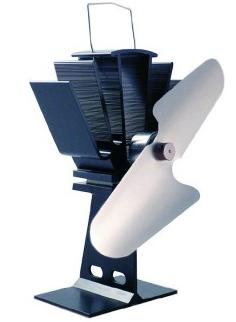
The
Ecofan range are a selection of fans designed to be mounted to the top of
woodburners which need neither batteries nor a mains power connection. Instead an Ecofan is powered by a
thermoelectric module which generates electricity using the heat differential between the base of the module in contact with the woodburner and the top of the module which is maintained at a lower temperature thanks to its connection to cooling fins. This type of thermoelectric generation is known as the
Seebeck Effect.
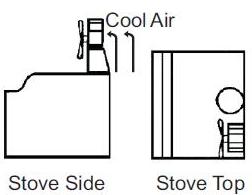
With the fan positioned as recommended (and shown above), the base of the fan gets very hot, but the temperature of the cooling fins is limited by (relatively) cool air flow. The hotter the woodburner gets, the faster the fan spins. If the fan were to be fitted in front of the stove pipe, then the cooling fins would be hot and the temperature differential would be low resulting in poor performance.
Buy an Ecofan
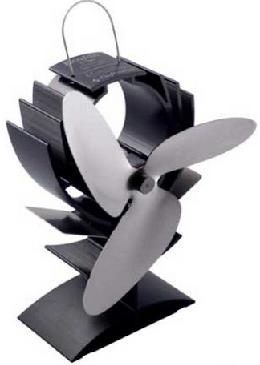
Two different ecofan models are available - the
Ecofan 800 rated to push 100 cfm (cubic feet per minute), and the larger
Ecofan 802 rated to push 150 cfm. These two models are available with either gold or nickel coloured blades.
The full range of Ecofans and their accessories and spare parts are available here:
Ecofans.
User manuals for these fans are available for free download here:
Ecofan 800 User Manual,
Ecofan 802 User Manual.
Article Last Modified: 14:10, 19th Nov 2010Comment on this Article
If you have any comments on this article, please email them to
neil@reuk.co.uk.
Recommended Related Articles
People who read this article also enjoyed the following articles:
Introduction to Water WheelsFind out more about using the power of a waterwheel
Article Last Modified: 10:16, 12th Nov 2008hydroSolar Greenhouse Heat SinkFind out how to make a solar powered heatsink for your greenhouse
Article Last Modified: 11:32, 24th Jun 2008solar | generalGreenhouse Heatsink Connection DiagramPutting together a solar powered greenhouse heatsink
system
Article Last Modified: 10:27, 31st Mar 2009solar | heating | generalDIY Solar Water Heating PrototypeFollow the construction of a successful DIY solar water heating prototype
Article Last Modified: 15:16, 19th Aug 2008solar | heating | waterGreywater Diverter ValveFind out about greywater diverter valves and how they are used in water recycling
Article Last Modified: 17:01, 18th May 2007waterWhat is a ShuntFind out what is a shunt resistor and how it is used in RE applications
Article Last Modified: 12:52, 28th Feb 2007electric circuit | educationPaper Log Briquette MakerFind out how to turn old newspapers into briquettes for the fireplace or stove
Article Last Modified: 15:44, 16th Sep 2011heating | recycling | biomass | carbonConnecting Water ButtsFind out how to connect two or more water butts to multiply available water storage capacity
Article Last Modified: 16:09, 1st Jun 2007waterFlush Toilet with Rain WaterFlush your toilet with collected rain water
Article Last Modified: 15:09, 21st Feb 2008water | education | generalHeat Recovery Ventilation SystemFind out more about heat recovery ventilation
Article Last Modified: 13:03, 16th Mar 2011heating | energy efficiency | shopping | general