

Anaerobic Digestion and Biogas
Anaerobic Digestion And Biogas
Find out more about anaerobic digestion for heat, biogas, electricity, and fertiliser
home > biomass
Since Marks and Spencer announced plans to become carbon neutral by 2012 anaerobic digestion has received its fifteen minutes of fame. UK high street giant Marks and Spencer plan to trial anaerobic digestion as a way of reducing the amount of waste they send to landfill and to heat some of their stores, offices, and distribution centres.
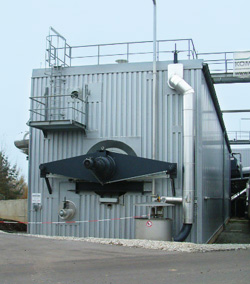
An anaerobic digester can be used to process any kind of organic matter from sewage to waste food products. Naturally occuring bacteria rapidly break down the matter (in the Marks and Spencer case food waste) into three main products: biogas - primarily methane (50-70%) and CO2, acidegenic digestate - similar to compost, and methanogenic digestate - a nutrient rich liquid.

The biogas can be used to produce renewable electricity or burned directly for commercial and domestic heating. The waste products can be used as fertilisers and soil improvers which are superior to chemical equivalents and environmentally friendly.
Although carbon dioxide is released during anaerobic digestion, the carbon was only recently absorbed by plants and so is part of a complete carbon cycle. This released gas does not contribute to global warming in the same way that carbon released from fossil fuels does - that CO2 has been trapped underground for millions of years.
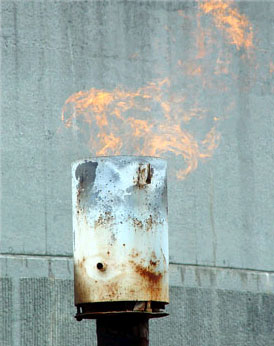
If the organic waste processed in an anaerobic digestor was instead dumped in a landfill site, the methane and carbon dioxide would be released into the atmosphere, so we should exploit the energy it contains. In addition, huge quantities of energy can be saved which would have been used to transport large volumes of waste to landfill. Currently most landfill sites simply collect and flare (i.e. burn) the methane gas generated underground wasting a valuable resource.
 Article Last Modified: 10:14, 31st Jan 2007
Comment on this Article
If you have any comments on this article, please email them to neil@reuk.co.uk.| Some of your facts are wrong and misleading. Our parish council have just left a planning meeting where a plan for a local landowner to install a unit to bring in 45000 tonnes of food waste from all over the west midlands has been referred to the secretary of state. It does not always stack up as a green procedure .spoiling an area were tourism has built up after many years of decline through coalmining. The digestate is very low in nutriment, 30 tonnes needed to replace just 6 tonnes of conventional fertilizer. It can not be used year on year, as the type of nitrogen is not easily given up to crops. It is slow release, and can contribute to nitrate and carbon release in the atmosphere, and water table pollution of nitrates. It’s main use is in restoration projects (covering up spoil heaps) where the slow release and humus are a benefit. And even in some cases burnt in bio-mass units (and that’s another problem with particle matter 2.5 emissions) or land filled. It seems we jump onto band wagons without proper scientific research into all the possible knock on effect. I believe small is beautiful in that respect. Small plants at the source of the waste and heat recovery I think are the way forward, but the real answer is to waste less, especially electricity. But it is no use relying on someone else to do it, we must all make a contribution. Ken December 15th 2008 |
Related Articles
Click one of the links below for further articles on the following relevant topics:biomass.