

EEStor Battery Ultracapacitor
EEStor Battery Ultracapacitor
Find out about a new battery for electric vehicles - 10 times the power of lead acid
home > storage | news | transport
Details of a new energy-storage technology are slowly being released by Texas startup EEStor. While electric motors and hybrid vehicle technology have improved at a huge rate during recent years, battery technology has remained static with weight, low energy storage, and cost being the main bottleneck in electric car development.
EEStor's alternative to current lead acid and lithium-ion battery technology is a parallel plate ultracapacitor using barium-titanate powders. EEStor claim that the new technology can store 10 times more power pound for pound than lead-acid batteries while costing half as much and without needing toxic chemicals.
According to the latest information available, full charge can be achieved in minutes rather than hours since overheating is not an issue (unlike existing battery technology), and hundreds of thounsands of recharge cycles are possible without performance falling. According to EEStor a 17kWh system could be charged in just 4-6 minutes. A 400lb 52kWh electrical storage unit (ESU) will eventually be marketed at $3,200 with prices falling to $2,100 with volume production.
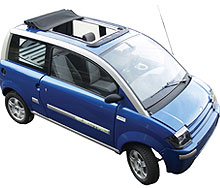
The first commercial application of the EEStor energy storage system will be the ZENN electric car (pictured above) manufactured by Canadian Feel Good Cars. ZENN are expecting delivery of the systems this year. The 15kWh electrical energy storage units (EESU) will recharge in minutes, weight under 45kg, and will operate in -20 to 65 degree Celcius ambient temperatures.
Find out more about ultracapacitors reading our What are Ultracapacitors guide.
EEStor Press Releases
EEStor Inc was founded by senior managers from Xerox PARC and IBM and is incredibly secretive about itself and its technology. Their corporate website http://www.eestor.us is currently just a holding page.Click here to view a January 16th 2007 press release from EEStor (PDF) announding that key production chemicals have been verified and their automated production line has been proven. Click here to view the January 18th press release from ZENN Motor Company (PDF) covering the same news.
 Article Last Modified: 08:54, 2nd Feb 2007
Comment on this Article
If you have any comments on this article, please email them to neil@reuk.co.uk.| Zenn is getting refocusing their business model toward licensing their EV control technology (ZENNergy drive) and not making the car anymore. See Zenn Press Release, and Zenn Business Strategy. Dan December 9th 2009 |
Related Articles
Click one of the links below for further articles on the following relevant topics:storage, news, transport.