

Worlds First Air Powered Car
Worlds First Air Powered Car
India to produce the world's first commercial vehicle powered by compressed air
home > transport | news

The world's first commercial vehicle powered soley by compressed air is being developed by MDI and manufactured by India's largest automaker Tata Motors.

Developed by Guy Negre (pictured above), an ex-Formula One engineer, the first commercial Air Car will be capable of hitting 68 mph and will have a range of 125 miles. MDI claim that their Air Car will be the "World's cleanest car with zero emissions".
Luxembourgh based MDI plan to sell 6,000 Air Cars in India during a product launch pencilled in for August 2008. Priced at around £7,000, the City-CAT (one of a proposed range of Air Cars) will be fitted with a carbon-fiber fuel-tank capable of holding 340 litres of air at 4350 psi. Some petrol stations will be installed with custom air compressor units capable of filling the tank in just a few minutes and for just £1.
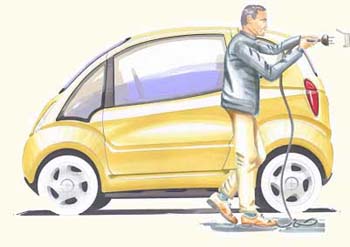
A electricity-powered air compressor unit will also be built into the City-CAT which will refill the tank in under six hours when plugged into a standard 230V mains power point. Pictured above is the smaller MiniCAT model which can be fuelled in under four hours at 230V. The cost of running the car will be under £1 per 100 miles travelled.
The City-CAT will have a fiberglass and foam body which is both lightweight and cheap to manufacture. MDI are currently investigating the use of hemp-fibre rather than fiber-glass to improve the environmental credentials of their vehicles.
The Air Engine
The Air Engine used in Air Cars is a piston engine which works in a very similar way to a steam engine. The pre-pressurised gas from the fuel tank pushes against a piston in exactly the same way that high pressure steam in a steam engine performs work against a piston.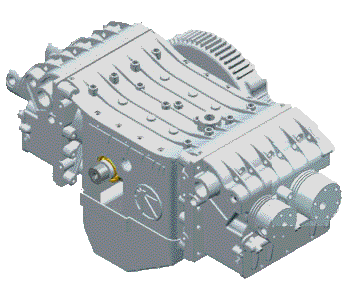
Because the air is filtered by a carbon-filter before it enters the engine, the engine emissions are actually cleaner than the air which went into the fuel tank! Emissions are 100% air at between -15 and 0 degrees Celcius. This cold air by-product can be used by the car's air-conditioning system to keep the passengers cool without using any power.
The absence of the combustion (and associated residue build up) found in today's petrol and diesel engines means that oil changes are only necessary once every 30,000 miles travelled. Just 1 litre of vegetable oil is required.
More Information
For more information about MDI Air Cars click here to visit the official Air Car website. Alternatively, click here to read a Wikipedia article on The Air Engine. Article Last Modified: 17:21, 25th May 2007
Comment on this Article
If you have any comments on this article, please email them to neil@reuk.co.uk.Related Articles
Click one of the links below for further articles on the following relevant topics:transport, news.