

solarDAB Solar Radio Review
SolarDAB Solar Radio Review
Product review for the Roberts solarDAB solar powered digital radio
home > shopping | solar | news
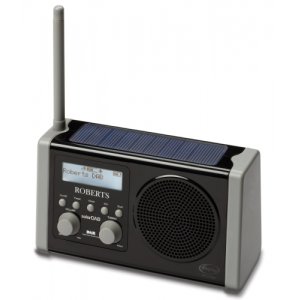
solarDAB is a product launched by Roberts in October 2008 - the first solar powered DAB (digital) radio on the market. In this article we will review solarDAB looking in detail at its usability, quality, and in particular at the solar panel charging capability.
Internal Battery Pack
Unlike some early wind-up and solar powered radios, the solarDAB has an easy to access bay in which the battery pack lives. By removing two screws, the battery bay cover can be removed.The battery pack is made up of three 1.2V NiMH cells rated at 2,000mAh connected in series, and therefore the battery pack is rated at 3.6V 2,000mAh. This is pretty high capacity, although it is possible to purchase (or put together your own) battery pack rated at up to 3,000mAh in order to increase playtime between charges. The battery pack plugs into a small socket in the battery bay and so can very easily be replaced after its 3-5 year likely lifetime (approximately 1,000 charges).
Mains Power
solarDAB is supplied with a 9.5V 500mA (5 Watt) mains transformer. This can be plugged into the back of the radio (2.1mm DC female connector) to power it and/or charge up the internal battery pack. There is a voltage regulator in the internal circuitry of the radio which outputs 5.40V to the battery pack charging it up.The supplied mains transformer is a high efficiency unit designed to minimise energy consumption.
Solar Power
A 140 x 35mm PV solar panel is integrated into the top of the radio to charge the internal battery pack and also to provide direct power to the radio. When the radio is turned on, a graphical bar chart displays the current level of solar power available.According to the Roberts solarSAB user manual, if more than 5 of 10 bars are showing, there is sufficient solar power to power the radio and charge the battery pack, however, even with 7 bars showing, if the battery pack is disconnected, the radio cannot be turned on. (In the instructions it is strongly recommended that the battery pack is ALWAYS installed when the radio is in use - but no reason is given for this).
The radio needs to be under direct sunlight if it is to be powered by solar energy alone - i.e. if the radio is not frequently left in direct sunlight it will be necessary to charge it up occasionally using the mains transformer. If the radio is left on a sunny window sill it will charge up, but more slowly than is the case when it is outside directly under the sun.
Because of the complexity of the internal circuitry, it is not possible to measure the maximum power output of the solar panel exactly without completely disassembling the radio, however we estimate it to be approximately 0.5-0.7 Watts. The minimum time to charge the battery pack fully from empty would be 4-7 sunny days, but if you listen to the radio for an hour or two every day and leave the radio in a sunny location all the time, you are unlikely to need to resort to the mains charger except in the depths of winter, or if you listen to the radio a lot.
Power Consumption
When the radio is plugged into the 9V mains transformer it draws 20mA constantly when switched off (due to losses in the internal circuitry) - therefore, it should not be left plugged in all the time. When the radio is switched on it draws 110mA (1 Watt) with the volume turned right down (or while using the headphones) rising up to 200-300mA when used at full volume (just under 3 Watts total consumption).By removing the battery pack and directly supplying 4 Volts to the radio it is possible to measure the rate of battery consumption by the radio. When the radio is switched off 0.00mA are drawn (which is good since you don't want the batteries to drain unnecessarily when the radio is not in use. When the radio is first switched on - display backlight on - 120mA are drawn (0.5 Watts), falling rapidly to 80mA whether headphones are used, the radio is used very quietly, or the radio is used as loud as you would typically want (0.3 Watts). Only when the radio is turned very very loud does the current draw jump up to just over 250mA (1 Watt).
It is claimed that this radio will operate for 27 hours from a full battery charge, but since 2,000mAh / 80mA = 25 hours this is probably a bit ambitious, with 18-20 hours being more realistic in the real world.
The DAB Radio
Overall this is an excellent and easy to use DAB radio. The instruction manual is comprehesive, clear, and well illustrated. From taking the radio out of the box, to setting it up and automatically tuning into the available digital channels takes just a couple of minutes. The display is excellent with the (mobile phone style) state of battery charge and signal strength shown in addition to the level of available solar charge. As with most DAB radios it is possible to set the display to show scrolling text (information about the currently playing artist name, track name etc), multiplex name, frequency, bit rate and audio type, and the current time.The radio is well built and sturdy, and the volume and tuning knobs operate smoothly. The ends of the radio are covered with quite a soft rubber/plastic compound. This stops the radio from sliding around where it is placed, and will also stop its corners getting damaged if it is dropped or bumped etc, but over time this material may start to get scratched and dirty.
DAB Band III is received via a solid 12cm long aerial. This aerial can be unscrewed and there is a handy holder moulded into the back of the radio into which it can be very securely stowed when not it use. This feature is particularly useful when you want to transport the radio to prevent the aerial and its mounting being damaged.
Buy solarDAB
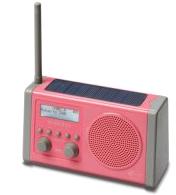
solarDAB is available in white, black, pink, red, or green. It is available at Ethical Superstore in all five colours for £79.95. Click here for more information and to buy solarDAB now.
 Article Last Modified: 10:26, 31st Mar 2009
Comment on this Article
If you have any comments on this article, please email them to neil@reuk.co.uk.Related Articles
Click one of the links below for further articles on the following relevant topics:shopping, solar, news.