

Buy a 12v Power Supply Unit
Buy A 12v Power Supply Unit
Find out more about 12V mains transformers and power supply units
home > electric circuit | storage | general
Across our many hundreds of articles we frequently present circuits, systems, and appliances which are powered by 12 Volts DC - primarily because the majority of all DIY renewable energy systems are connected to 12V battery banks. However, we receive so many questions from REUK.co.uk site visitors asking us where to purchase a suitable plug-in power supply (mains transformer / PSU) that we have put our recommendations together in this one article.
Low Power - Less than 1 Amp
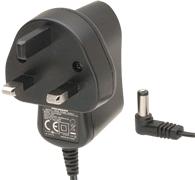
Look out for regulated power supplies (much better for sensitive electronics), and efficiency of at least 60%.
Rapid Online
5W Switch Mode Plugtop PSU (400 mA, 60% efficient)
15W Switch Mode Plugtop PSU (1.2 mA, 75% efficient)
Medium Power - 1.5A to 10A
Once you get to above 1.2 to 1.5 Amps, power supplies become a bit harder to find and are more expensive. However, they also tend to be made of better quality components, and are more efficient.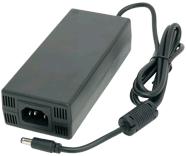
Rapid Online *
25W 12V DC Miniature Desktop Switch Mode PSU (2 Amp, 80% efficient)
65W 12V DC Miniature Desktop Switch Mode PSU (5 Amp, 80% efficient)
90W 12V DC Miniature Desktop Switch Mode PSU (7 Amp, 80% efficient)
120W 12V DC Miniature Desktop Switch Mode PSU (10 Amp, built-in cooling fan)
* The Rapid products listed above have a built-in IEC320-C8 mains power inlet. A separate figure-of-8 power lead with plug must be purchased, but these are only £2 at Rapid: click here to buy now.
High Power - more than 10 Amps
Above 10 Amps (120 Watts) it becomes very difficult to find a power supply that is not very expensive. One common solution is to use a computer power supply unit. These are available from a couple of hundred Watts up to 1kW, and can therefore reliably supply 20, 30, 40 Amps etc cost effectively and fairly efficiently.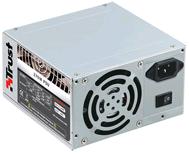
Computer PSU's are usually fitted with at least three or four output 12V connectors, so you may need to cannibalise a suitable output cable to get your 12 VDC output without opening up the case of the PSU.
One key advantage of using computer PSU's in this way, is that they are fitted with strong and quiet cooling fans as they are designed to be used in offices. Typically they offer 70% efficiency, however green power supply units are available now which give over 90% efficiency.
eBay UK
There are usually 3,000+ computer PSU's and other PSU's for sale on eBay UK at any one time. Click here to search now for PSU with prices starting from below £5.
Rapid
370W Computer PSU (30 Amp, 80mm cooling fan, just 37dB noise level, under £15 inc VAT)
Modifying a Computer PSU
Computer PSU's typically output +5V (yellow cables) and +12V (red cables), and the ground cables are black. (Sometimes there is also a low current -5V (white cable), -12V (blue cable), and power good (orange cable) which you will not be using.) The cables are fitted to connectors ready for quick plug-in connection to the computer motherboard, CPU, hard drive, etc. Simply cut off the connector plugs, group the wires of each colour together - i.e. all the reds, all the yellows, all the blacks - and solder the ends together.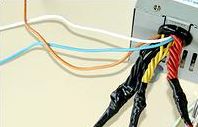
The current rating for each output from the PSU should be printed on the PSU case, so simply add up the total +12V Amps to calculate the absolute maximum current which can be taken from the PSU at 12 Volts DC. Put a fuse between the soldered end of the bundled red wires and the device to be powered for safety. Ideally the fuse should be rated at 10-20% below the maximum stated PSU +12V current rating, and you should use no more than 60-70% of the available current.
Make sure that the cable you use between the PSU and the device to be powered has a current rating in excess of that required by the device to be powered.
 Article Last Modified: 22:20, 24th Sep 2014
Comment on this Article
If you have any comments on this article, please email them to neil@reuk.co.uk.| Just been converting (messing around with) an ATX PSU for a +ve 12v supply. Not sure if you have got your colours mixed upon here. On this [power supply], the +ve 12v are the yellow wires and the +ve 5v are the red wires. See here: power supply basics inc pinouts. Also, there is a green wire that has to be connected to ground(Black) to get the PSU running. Dave, 2nd March 2011 |
Related Articles and Products
More from the REUK.co.uk website:| Minimising Line Losses in RE Systems Select wire of the correct diameter for your renewable energy system  | Simple Solar Tracker Concept Make a very simple sun tracker to maximise electricity generation from a PV solar panel 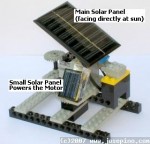 | LM317 Adjustable Power Supply Find out how to build an adustable power supply with an LM317T voltage regulator 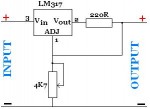 | Control Mains Powered Devices with Low Voltage Switch mains powered devices on and off safely and simply with low voltages  |
| 12 Volt Battery Low Indicator LM741 Plans for a battery low indicator for a 12 Volt battery using an LM741 operational amplifier 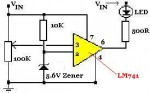 | Three Phase Bridge Rectifier Find out about three phase bridge rectifiers 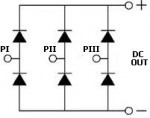 | Using The LM317T To Regulate Voltage Use an LM317T to regulate voltage in renewable energy projects  | LM317 Voltage Calculator A handy online output voltage calculator for the LM317, LM338, and other linear voltage regulators  |
electric circuit, storage, general.