| RSS Web Feed for Renewable Energy UK | REUK Shop | Bookmark Site | About Us  

Interconnecting Batteries for Battery Bank


Interconnecting Batteries For Battery Bank

Find out how best to connect batteries together into a battery bank

storage
Printer Friendly Version Print Article     

For any off grid renewable energy system the battery bank is probably the most important component. It doesn't matter how much power you generate - if it is not stored safely and efficiently then you will have no electricity when you need it. Batteries are also one of the most expensive parts of wind, solar, and hydro power generation systems so they need to be well cared for.

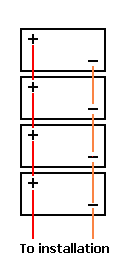
Unless you have a very small system you will need more than one battery - therefore you will need to connect the batteries to one another to form a battery bank. Below is an illustration from SmartGuage Electronics showing how this is often done:
The old way of connecting batteries together into a battery bank

The Problem

Because of the small amount of resistance in the cable used to interconnect the batteries, and from the connection between the cable and the battery posts, the battery closest to the installation is charged the most, discharged the most, and worked harder, whereas the battery furthest from the installation is charged the least, discharged the least, and worked the least.

The Reason

The power from the bottom battery has to pass through the main connection leads whereas the power from the top battery has to pass through the main connection leads and another four sets of interconnecting leads. Although the resistances are tiny - it is the fact that they are so small that makes them have such a big effect on the current flowing to each battery.

SmartGuage Electronics used a computer simulation in 1990 to calculate the following assuming a battery internal resistance of 0.02 Ohms, interconnecting lead resistance of 0.0015 Ohms per link, and a total load on the batteries of 100 amps:

The bottom battery provides 35.9 amps.
The next battery up provides 26.2 amps.
The next battery up provides 20.4 amps.
The top battery provides 17.8 amps.

...which means the battery closest to the installation is worked twice as hard as the battery at the top of the battery bank! These surprising findings have since been reproduced in real world situations.

Connecting Batteries in a Battery Bank

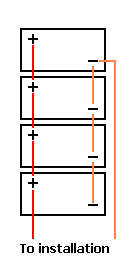
So it the example given above shows you how NOT to connect batteries to make a battery bank, how should you do it? It is actually very simple - instead of taking the negative AND positive feeds from the same battery (in the example above it was from the bottom battery) , you should take one feed from each end of the interconnected battery bank - e.g. +ve from the top battery and -ve from the bottom battery. See the image below from SmartGuage Electronics:
The new way of connecting batteries together into a battery bank
With the same example load of 100 amps presented above the new loads on each battery are as follows:
The bottom battery provides 26.7 amps.
The next battery up provides 23.2 amps.
The top battery provides 26.7 amps.

To get the batteries perfectly balanced requires a different scheme involving a little more work and expense (more cables and connections required), but is only really necessary if you have very expensive batteries or a more than 6 or so batteries in your bank.

Click here to find out how to Make a Simple Battery Bank Status Monitor.

Find out More about Connecting Batteries into Banks
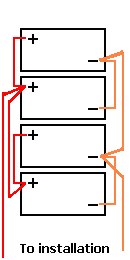
To find out more about interconnecting batteries the right way in your particular case take the time to read the SmartGuage Electronics article Interconnecting Multiple Batteries to Form One Bank. It's well worth a read if you are about to make a battery bank.

Warning: Be Safe When Handling Lead Acid Batteries

When handling lead acid batteries, great care must be taken. You should always wear gloves and safety goggles because if acid sprays or spills from a battery onto your skin or eyes you could sustain a serious and permanent injury. Invest in a bottle of surgical eye wash and leave it next to your battery bank at all times so you can flush your eyes immediately if you get acid in your eye.

Article Last Modified: 13:53, 23rd Feb 2007


Recommended Related Articles

People who read this article also enjoyed the following articles:

Make a Simple Battery Status Monitor
Monitor battery status with this easy electric circuit project - no skill required!
Article Last Modified: 12:33, 16th Mar 2007
storage | electric circuit

DIY 2kW Wind Turbine
Read about a home built 2kW wind turbine constructed from scrap
Article Last Modified: 08:46, 4th Oct 2007
wind | recycling

Permanent Magnet Generator
Build a wind or water power system with around a PM Generator
Article Last Modified: 17:33, 2nd Jan 2008
wind | hydro

Switch from Inverter to Mains Automatically
Power a circuit directly from a power inverter, but with automatic mains power back up.
Article Last Modified: 16:55, 4th Sep 2007
electric circuit | storage | general

MiniWind Wind Turbines
Find out more about the MiniWind range of wind turbines and purchase products with an REUK exclusive 10% discount
Article Last Modified: 17:33, 2nd Jan 2008
wind | shopping

Power Inverters
Find out about the uses of power inverters in renewable energy generation
Article Last Modified: 16:48, 6th Dec 2007
storage | general | electronics

How I Built A Wind Turbine
Read how a wind turbine was built for under US$150
Article Last Modified: 10:24, 6th Jan 2007
wind | education

Battery Desulfation
Find out how to desulfate/desulphate and rejuvenate lead acid batteries
Article Last Modified: 11:25, 26th Mar 2008
storage

PVC Wind Turbine Blades
Learn how to make your own PVC wind turbine blades
Article Last Modified: 11:59, 24th Jan 2007
wind

Shed and Garage Solar Lighting
Light your shed or garage with solar powered lighting
Article Last Modified: 11:19, 26th Mar 2008
lighting | solar

© 2006-2008 REUK - All Rights Reserved
Page Last Updated on 7th May 2008 at 09:27:37am

Latest
Articles


Wind Turbine Axial Flux Alternators
Learn more about the design of an axial flux alternator - used in wind turbines and hyrdo power
wind
09:27, 7th May 2008

Solar Water Heating Pumping Station
Find out more about the new solar water heating Pumping Station
solar
11:53, 6th May 2008

Moonlight Night Light Product Review
A review of the Moonlight Night Light
shopping
14:00, 30th Apr 2008

P3 Kill a Watt PS P4320
Find out more about the Kill-a-Watt Power Strip P4320
energy efficiency
13:20, 30th Apr 2008

Calculation of Wind Power
Calculate the power of the wind hitting your wind turbine generator
wind
15:06, 18th Apr 2008

Renewable Obligation Certificates
Generate renewable source electricity and get paid twice with ROCs
general
11:37, 15th Apr 2008

Jobs in Renewable Energy
Find a job in renewable energy and green technologies
general
12:16, 8th Apr 2008

Rainwater Toilet Flush System
Find out how to put together a complete rainwater fed toilet flushing system
water
10:50, 5th Apr 2008


REUK Shop

Popular Items


KILL A WATT
Plug in Mains Power and Energy Monitor
£19.99 each.
Energy Saving


EFERGY HOMECO2METER
efergy homeCO2meter wireless electricity monitor
£38.99 each.
Energy Saving


240V LED SPOTLIGHT BULB
240V LED GU10 bulb. 20 x 20,000mcd white LED 1 Watt bulb
£4.99 each.
Energy Efficient Lighting


RAINWATER DIVERTER KIT
Rainwater diverter kit for standard plastic 65mm square and 68mm round downpipes
£8.99 each.
Water Conservation


300 WATT POWER INVERTER
Convert 12V DC battery power into 230 AC to power portable televisions, computers, video recorders etc. 300 Watt power rating - peak power 600 Watts
£29.99 each.
Renewable Energy System Parts


12 VOLT 3 WATT SOLAR PANEL
Waterproof 12 Volt 3 Watt Solar Panel - 199 x 136mm with fitted leads (fiberglass and resin).
£19.99 each.
Solar Power


SUNGUARD SOLAR CONTROLLER
4.5 Amp at 12 Volt solar charge controller - fully encapsulated and weatherproofed
£22.79 each.
Solar Controllers