If we received 1p every time someone emailed us about solar powered poultry lighting we would have earned 23p during September (2006). Therefore we have compiled the information in the following article to assist those people, and anyone else who requires timer controlled lighting where mains electricity is not available.
NEW – in addition to the detailed information in this article we recommend you read our new articleREUK Poultry Lighting System. There we have taken our last two years of experience and put together all the information you’ll need to put together a tried and tested reliable solar (or otherwise) poultry lighting system based around our newly launched economical REUK poultry lighting controller.
The New REUK 2010/2011 Super Poultry Lighting Controller
NEW Version 3 of our poultry lighting controller, the REUK Super Poultry Lighting Controller is now available for sale in our REUK Shop. Click here to purchase and/or for more information: REUK Super Poultry Lighting Controller.
Poultry Lighting
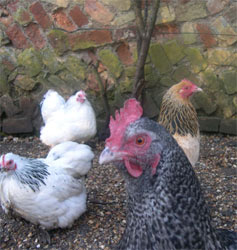
One of the most important factors in egg production by poultry is the length of the day. During the summer months when days are long, hens and other poultry lay merrily. But in the winter when the days are short (and often dull) egg production can slow or even stop. Therefore artificial poultry lighting on a timer is often used to trick the poultry into believing the days are longer while still maintaining the necessary 9-10 hours of dark roosting time.
The Timer
Key to any artificial poultry lighting system is a programmable timer. While 240 VAC mains electricity programmable timers are available for just a couple of pounds, unfortunately the same is not true of 12 Volt DC timers. In our article 12 Volt Programmable Timer Switch we looked at some of the commercial products available. A reader of our site then made the excellent recommendation that a cheap battery powered programmable thermostat can be used as a timer. You simply need to set the timer to be on from say 4:00am until 7:00pm every day.
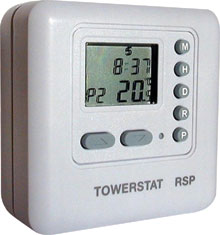
We sell the programmable thermostat pictured above in the REUK Shop. Click here to purchase this battery powered timer thermostat.
Choosing Lights
Poultry lighting by definition is used during the months when there is little sunlight. Therefore everything needs to be done to keep the power used by the artificial lights to an absolute minimum since the amount of solar electricity which can be generated is small – typically just a couple of hours per day. Fortunately the latest 12 Volt DC LED spotlight technology uses very little power – our LED Spotlights (available in the REUK Shop) use just 1 Watt of 12 Volt DC electricity.
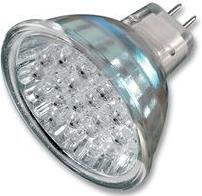
These spotlights (pictured above) can be used to light spaces as well as being excellent spotlights. For general lighting in a small space it may be better to direct the bulbs * onto a reflective surface (e.g. mirrored card) on the roof of the poultry house so that the light reaching the poultry is not too bright and to reduce shadows.
* The number of bulbs required will depend on the number of poultry and the size of their accommodation.
Automatic Light Switch Off in Daylight
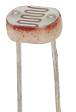
A cheap way to save power (and therefore to reduce the overall costs of the system) is to use a small light dependent resistor circuit to automatically switch off the artificial lights when the natural daylight outside the poultry house is sufficiently bright to render them unnecessary. Typically this would result in the lights being off from around 9:00am until 4:00pm in the Midlands of England saving seven hours of power.
NEW The one disadvantage of using this thermostat timer is that only one ON and one OFF can be programmed per day – therefore necessitating the above described daylight detector to reduce power consumption. Click here to read our new article Convert Digital Mains Timer to Low Voltage in which we describe how a supermarket bought mains powered programmable timer (with multiple ON/OFFs per day) can be modified and a relay board added so that it can be used in this application – for example, ON from 4am to 8am and then again from 4pm to 7pm, and therefore OFF at night and from 8am-4pm.
The Solar Panel and Battery
Since the PV solar panel will only be generating its rated amount of power for a couple of hours per day at most, the panel has to be sized to ensure that sufficient electricity is sent to the battery. Therefore if a 1 Watt bulb is to be powered for 10 hours per day, a solar panel of at least 5 Watts would be required and a 10 Watt panel would be preferable.
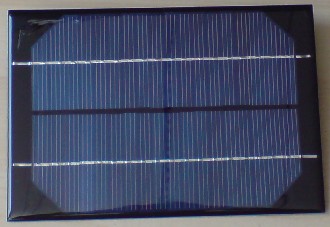
The battery needs to hold sufficient charge to get through a week of zero sunshine without being damaged (i.e. not discharged below around 40-50% of capacity). Therefore a standard sized 85 to 110Ah deep cycle leisure battery is easily sufficient for 4 or 5 Watts of bulbs. Using such a battery with a solar panel of less than 20-30 Watts will typically render a solar charge controller an unnecessary expense (during late autumn, winter, and early spring), although using one with a solar panel over 20 Watts will increase the life expectancy of the batteries a little and a suitable solar controller should be used in the summer months.
Total System Costs
The most basic system of one 1 Watt LED spotlight bulb (and bulb holder) could be powered by a couple of our 12 Volt 3 Watt Solar Panels (connected in parallel for 6 Watts power output) for under £50. The programmable thermostat, battery, light/dark sensor circuit, and cables and connectors could be purchased again for under £50 providing a complete robust system for under £100.
Connecting The System
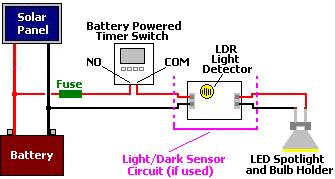
Above is a basic schematic diagram of a solar powered poultry lighting system comprising one solar panel, one LED spotlight bulb, a modified thermostat timer, and a light detector.
Below is the schematic for the more advanced system based around a modified programmable timerwith voltage regulator (to supply the necessary 1.2V to the timer from the main 12V battery) and relay board (to switch the lights on and off).
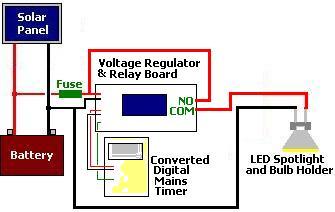
If a second solar panel is required to keep the battery topped up, it should be connected in parallel with the first panel: connect the positive lead from panel 2 to the positive of panel 1 and then connect the negative lead from panel 2 to the negative lead of panel 1.
If more than one light is required, additional lights must again be connected in parallel with the first bulb as shown in our article on solar powered shed lighting.
If you need any help or advice in putting together a poultry lighting system using any of the products and methods described in this article, please contact neil@reuk.co.uk with details of your exact requirements.
Comments
As a poultry keeper, the usual trick with extending daylight in the coop is do add artificial light only at the BEGINNING of the day. If you try to add light at the end of the afternoon, free-range chickens/ducks get confused. The sun starts to set, and they go into the coop to roost. But it’s still lit, so they go outside again!
Experience tells me that this confused state yields no additional eggs…. and the confusion may have the opposite effect! Other customers of REUK may wish to comment further on my observation of
course.But as your webpage stands, I think the advice should only be used if the poultry is permanently kept indoors.
Paul
November 19th 2008