| RSS Web Feed for Renewable Energy UK |  | REUK Shop | Directory | About Us  

Convert External PIR to Low Voltage


Convert External PIR To Low Voltage

Convert a mains powered outdoor PIR sensor to operate on low voltage

electronics | education | electric circuit | shopping
  Printer Friendly Version Print Article     

There are many affordable mains powered outdoor rated PIR sensors available, and many affordable low voltage indoor rated 12V Pir Sensors, but there are very few low voltage outdoor rated PIR sensors available and those which are available tend to be quite expensive - typically 3x or more the price of mains powered units.
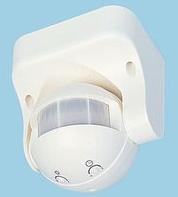
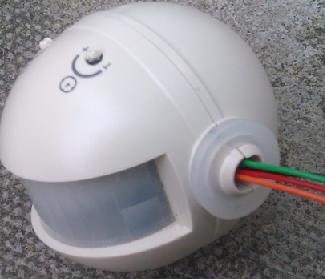
ES34 mains powered external PIR motion sensor - converted to low voltage 12VDC operation


In this article we will look at how a good quality but low priced mains powered security motion sensor can be easily modified for 12V DC operation with the addition of a few components and a little soldering. Our chosen PIR sensor is pictured above, and is available for sale here: ES34 External PIR Light Controller at less than £15.

This unit is supplied with all fixtures and fittings for external wall mounting, it is fitted with an internal light detector (user adjustable) so that the PIR can be used to trigger lighting only at night, it has a detection range of 12 metres over 180°, the angle of the PIR sensor can be adjusted, and there is space within the unit to add the necessary components to enable 12 Volt DC operation. The time the output is turned on for after motion is detected is user adjustable from 5 seconds to 12 minutes.

Converting the PIR Sensor

The unit is made up of the PIR sensor housed in a ball which is held by by arms attached to a case which contains the terminal strip to which the mains cables would normally be connected. Follow the instructions supplied with the unit to unscrew the back of the case to give access to the mains connections. Unscrew the three wires which are connected to the terminal strip and remove the terminal strip.
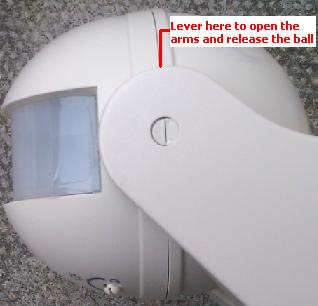
Lever open the arm of the case so that the PIR ball comes free


Now use a small flat headed screwdriver to lever the arm outwards (as shown above) so that the PIR ball is released from the case. Pull the cables which exit the PIR ball out from the case.

Pull out the two adjusters (LUX and time) from the ball and put them somewhere safe. It is easiest to lever them up with the small screwdriver and then pull them out with pliers or tweezers. (Note that if you rotate both of the adjusters all the way anti-clockwise before you remove them, it will help you get them back in the correct position later on.)

Using the same small screwdriver, split the ball in half pushing the screwdriver into the join between the two hemispheres on the opposite side from the opening through which the cables exit. With gentle pressure the ball will pop one revealing the electronics inside. There is a screw in the centre which holds everything in place. Remove this screw, and then release the circuit boards.
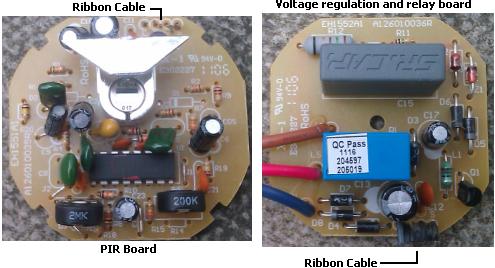
Internal electronics of a mains powered PIR sensor

Pictured above are the two circuit boards. The one on the right contains the voltage regulation components which bring the mains voltage down to 24VDC, and a 24VDC relay. Unfortunately this relay cannot be energised by 12 Volts, and so this board will be discarded and replaced with a suitable 12V relay. The board on the left is the PIR board with the PIR sensor itself, user adjusters for LUX and time, and the microcontroller which manages everything. This is the board we will be keeping.

The two boards are connected by a ribbon cable. Cut this cable, cutting it all the way to the circuit board on the PIR board, and discard the other board.
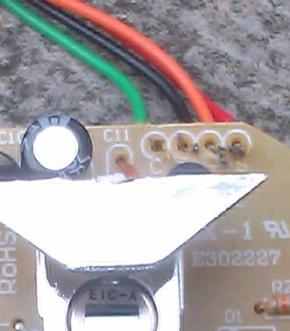
Solder four leads to the terminals which held the ribbon cable

Four leads need to be soldered to the four terminals to which the ribbon cable was connected as shown above. To avoid confusion later on (and a destroyed PIR sensor) it is best to use a different colour for each lead.
Hacked PIR sensor clipped back together

Now clip the PIR sensor ball back together as shown above having first refitted the adjuster in the same positions they were before you dismantled the ball.

Using the colours we have used, we need to make the connections as follows:
green: connects directly to +ve of 12VDC supply.
black: connects directly to the -ve of 12VDC supply.
orange: connects to +ve of 12VDC supply via a 1K resistor.
red: connects to the base of a transistor via a 1K resistor.
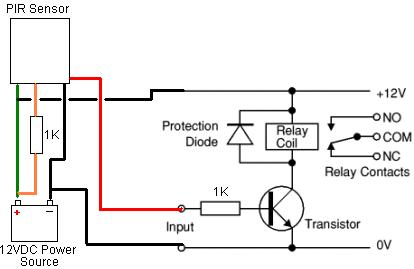
Wiring diagram for the additional electronics for an external PIR sensor modified for low voltage 12VDC operation

Everything ends up connected as per the circuit diagram above. Space is quite tight inside the PIR unit, so it is best to use a physically small relay and solder everything together as closely as possible. With that completed and tested squeeze the PIR ball back into place, screw the back of the case back on, and everything is ready to use with 12VDC.

Many thanks to Dave Hadden from Hadden Alarms for his help with this article:
Hadden Alarms have been trading in Aberdeen for 20 years. Our main areas are installing Alarm Systems, CCTV Systems, Access Control and repairs to these and associated products. We provide solutions to our customers requirements by combining various areas of expertise including the ability to interface different systems ie Alarms, CCTV, Lighting and phone signalling to work together. Many thanks to REUK, whose many circuit examples and projects are a regular source of reference for us.


Article Last Modified: 15:31, 20th Feb 2012

Comment on this Article

If you have any comments on this article, please email them to neil@reuk.co.uk.


Recommended Related Articles

People who read this article also enjoyed the following articles:

Low Voltage Battery Disconnect Circuits
Find out more about low voltage battery disconnect (LVD) circuits - used to protect batteries
Article Last Modified: 12:47, 31st Mar 2012
electric circuit | electronics | storage

LM317 Voltage Calculator
A handy online output voltage calculator for the LM317, LM338, and other linear voltage regulators
Article Last Modified: 12:29, 17th Aug 2010
electric circuit | electronics | general

Hacked PIR Sensor
Cannibalise a cheap PIR sensor to put it to other uses
Article Last Modified: 10:44, 4th Feb 2012
electronics | education | electric circuit

PIR Sensor Circuits
Find out more about using PIR sensors within renewable energy applications
Article Last Modified: 12:42, 4th Feb 2012
electronics | electric circuit | general | solar

LED Dimmer Circuit
Find out how to put together a simple but efficient PWM dimmer circuit for LEDs
Article Last Modified: 09:42, 16th Mar 2011
lighting | electronics | electric circuit

Convert Digital Mains Timer To Low Voltage
Convert a cheap digital mains timer into a low voltage programmable timer relay
Article Last Modified: 10:21, 15th Nov 2008
electronics | electric circuit | general

LM317 High Current Voltage Regulator
Find out how to build an LM317T based high current voltage regulator
Article Last Modified: 12:29, 17th Aug 2010
electric circuit | electronics | general | education

Light Dark Dawn Dusk Relay Controller
Find out about the REUK Super LDR light/dark dawn/dusk relay controller
Article Last Modified: 16:48, 24th Jan 2012
electric circuit | electronics | news | shopping

Using The LM317T To Regulate Voltage
Use an LM317T to regulate voltage in renewable energy projects
Article Last Modified: 15:04, 7th Mar 2008
electric circuit | electronics

PICAXE Microcontrollers
Find out about PICAXE microcontrollers and their use in renewable energy projects
Article Last Modified: 13:12, 30th Jan 2012
electronics | electric circuit | education

© 2006-2012 REUK - All Rights Reserved
Page Last Updated on 9th May 2012 at 03:40:34pm

Latest
Articles


Wind Turbine Insurance
The importance of wind turbine insurance and what to look for
wind
12:57, 5th May 2012

Solar Insolation
A measure of the amount of solar radiation hitting the earth
solar
10:12, 5th May 2012

Virtu Hybrid Solar PV Water Heating
Find out about a new hybrid solar PV and water heating panel - Virtu
solar
13:10, 26th Apr 2012

External Solid Wall Insulation
Find out about solid wall insulation applied to external walls
energy efficiency
13:10, 26th Apr 2012

Logic Energy WindTracker
Find out more about the Logic Energy Wind Tracker
wind
08:43, 13th Apr 2012

Low Voltage Battery Disconnect Circuits
Find out more about low voltage battery disconnect (LVD) circuits - used to protect batteries
electric circuit
12:47, 31st Mar 2012

UK Feed in Tariff to be Cut by 50 Percent
UK government announces 50% cut in feed in tariff payable on new solar PV installations
solar
09:56, 24th Mar 2012

Jobs in Renewable Energy
Find a job in renewable energy and green technologies
general
20:34, 8th Mar 2012


REUK Shop

Popular Items


REUK SUPER LDR DUSK DAWN RELAY CONTROLLER
Multi-function light detector triggered light/dark dawn/dusk relay controller
£18.95 each.
Complete Circuits


KARASOULI SCC 20 CHARGE CONTROLLER
20A rated wind turbine charge controller and dump load controller with blocking diode and heatsink
£43.95 each.
Renewable Energy System Parts


SOLAR PUMP CONTROLLER WITH RELAY
Solar water heating system microprocessor controlled circuit with fitted 10A relay
£25.99 each.
Complete Circuits


REUK SUPER POULTRY LIGHTING CONTROLLER
Control up to 8 Watts of LED spotlights to stimulate egg production in birds
£29.99 each.
Complete Circuits


REUK SUPER TIMER 2
User programmable 12VDC powered 16A rated repeating relay timer. 1 second to 99 hours ON and OFF times
£23.99 each.
Complete Circuits


300 WATT POWER INVERTER
Convert 12V DC battery power into 230 AC to power portable televisions, computers, video recorders etc. 300 Watt power rating - peak power 600 Watts
£29.99 each.
Renewable Energy System Parts


CONVERTED PROGRAMMABLE DIGITAL TIMER RELAY
Mains powered programmable timer converted to low voltage with relay board
£21.99 each.
Renewable Energy System Parts


12 VOLT REGULATOR
Supply a fixed 12.0 Volt DC to your devices (up to 1 Amp output)
£4.99 each.
Complete Circuits


MR16 CERAMIC BULB HOLDER
Bulb holder for 12 Volt LED spotlight bulbs
£1.39 each.
Energy Efficient Lighting