Battery Terminals
Battery Terminals
Find out how to connect cable safely to the terminals of a battery or battery bank
storage | shoppingWhen using a
battery or
battery bank in a
renewable energy system it is essential to ensure that all cables are fastened very securely to the terminal posts of the battery. If you look under the bonnet of a car at the
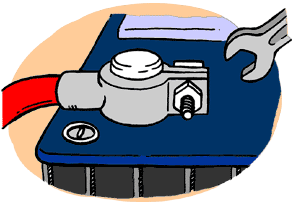
battery you will see that the positive and negative cables of the electrical system are bolted to the battery using
battery terminals. These should also always be used in renewable energy system battery banks.
If for example a
wind turbine is connected to a
battery bank and one of the power cables disconnects from the battery, the wind turbine will spin faster and faster out of control. This is dangerous both to the turbine itself and to people, animals, and property nearby.
Battery Top Post Terminals
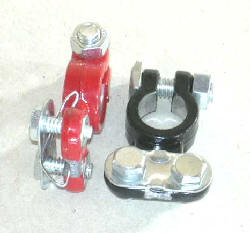
Pictured above is a pair of
battery top post terminals (available on sale in the
REUK Shop). These can be bolted onto the
terminal posts of 12 Volt
leisure, marine, and motor car batteries. The red terminal should be fixed to the postitive post of the battery, and the black to the negative post. The cable which is to be connected to the battery is then sandwiched between two metal plates on the terminal and can be bolted safely and securely in place.
These
battery terminals will accept cable up to 40mm
2 in area - equivalent to a diameter of around 7.2mm corresponding to AWG 7. (click here to view our
AWG wire size converter. The majority of battery terminals accept wire with a diameter of up to 8mm however battery terminals from lorries and other heavy vehicles can sometimes have a 10mm cable entry.
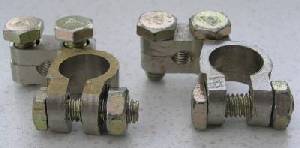
Where different colours are not used (see image above),
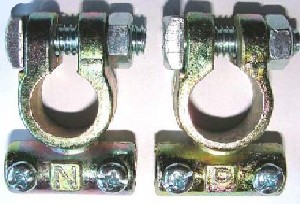
battery terminals will be marked with an
N for negative, and a
P for positive as shown below.
Article Last Modified: 10:50, 23rd Mar 2007Comment on this Article
If you have any comments on this article, please email them to
neil@reuk.co.uk.
Recommended Related Articles
People who read this article also enjoyed the following articles:
Make a Simple Battery Status MonitorMonitor battery status with this easy electric circuit project - no skill required!
Article Last Modified: 12:33, 16th Mar 2007storage | electric circuitInterconnecting Batteries for Battery BankFind out how best to connect batteries together into a battery bank
Article Last Modified: 13:53, 23rd Feb 2007storageBattery DesulfationFind out how to desulfate/desulphate and rejuvenate lead acid batteries
Article Last Modified: 16:56, 5th Oct 2009storage | electronicsPure Sine Wave Power InvertersFind out more about pure sine wave inverters and their use
Article Last Modified: 16:52, 21st Jul 2008storage | generalSolar Battery Charger With LM317TFind out how to make a current controlled solar battery charger using an LM317T
Article Last Modified: 09:34, 30th Mar 2007solar | education | electric circuitSolar Battery ChargingMake a solar charger for NiCd and NiMH rechargeable AA, AAA etc batteries
Article Last Modified: 09:43, 30th Jul 2007solar | educationUK Renewable Energy Degree CoursesStudy renewable energy at university in the UK
Article Last Modified: 11:18, 29th Oct 2009education | generalUnderstanding BatteriesLearn more about all types of batteries - particularly rechargeable batteries
Article Last Modified: 15:28, 22nd Apr 2009storage | websites | educationZener Diode Voltage RegulatorMake a simple zener diode voltage regulator
Article Last Modified: 17:31, 7th Mar 2008electric circuit | educationAWG to Square mm Wire Size ConverterConvert between AWG, inches and mm diameter, and square mm area measures of wire size
Article Last Modified: 06:45, 19th Jul 2008storage | electric circuit