| RSS Web Feed for Renewable Energy UK |  | REUK Shop | Directory | Bookmark Site | About Us  

Biodiesel Recipe


Biodiesel Recipe

Read a recipe for making biodiesel

biomass | transport
Printer Friendly Version Print Article     

The recipe for making biodiesel is very simple although there are plenty of dangers involved. This recipe is here for information purposes only and we do not recommend that you attempt to make biodiesel at home. Protective chemical proof gloves, an apron, and goggles must be worn, and vapours released are poisonous so a dust mask is recommended.

Danger hazard label

Vegetable oil is too thick to use directly in a diesel car's engine. Therefore its viscosity must be reduced using a chemical process which strips the glycerin from the esters (vegetable molecules). By replacing the glycerin with an alcohol (methanol or ethanol) by the process of transestrification we obtain a useable fuel - biodiesel. As vegetable oil is acidic, an alkaline (sodium hydroxide NaOH also known as lye or caustic soda) is used to break the molecules.

The following details are for new unused oil. If you intend to use old vegetable oil then the amount of sodium hydroxide must be modified to take into account the increased acidity and extra free fatty acids that need to be neutralised before they gunge up your fuel lines.

To make a sample amount of biodiesel - e.g. 1 litre you need the following:
1. 1 litre of vegetable oil.
2. 200 millilitres of methanol (95% pure).
3. 5 grams of sodium hydroxide.

The first step is to dissolve the sodium hydroxide in the methanol to generate sodium methoxide. This must NOT be done in a plastic bottle as the sodium hydroxide will attact the bottle and fill it with holes. Instead use a large glass jar with a very tightly fitting lid. Drop the sodium hydroxide into the methanol, replace the lid immediately, and shake/swirl the mixture for around 10 minutes until all of the sodium hydroxide has dissolved. A lot of heat will be generated during this process.
Then this solution is added to the vegetable oil which has been pre-heated to 60°C. Get a 2 litre plastic drinks bottle and a funnel. Pour the warm oil through the funnel into the bottle and then (in a well ventilated area) add the methoxide. Remove the funnel and replace the top on the bottle screwing it down tightly. Shake the bottle vigorously for 30 seconds. For best results shake the mixture for 5 seconds four times over the space of one hour.
The mixture can then be left to settle with biodiesel appearing at the top, and glycerine at the bottom. Within an hour most of the glycerine will have settled out, but it is best to leave the mixture overnight to settle more fully. Next morning slowly pour off the biodiesel to use as fuel and put the glycerine on your compost heap or use it to make soap.
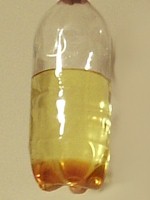
Biodiesel on top, glycerine at the bottom

To improve the quality of your biodiesel it should be washed in order to remove the soap it contains. To do this pour your one litre of biodiesel into another two litre bottle. Add 1/2 litre of 40°C water gently to the bottle. Replace the bottle top tightly and then turn the bottle end over end gently for 30 seconds. As long as you are gentle, the cloudy (soapy) water and biodiesel will seperate quickly. Turn the bottle upside down and slowly release the water (which will form a layer at the bottom) using your thumb as a valve. Repeat this process 2 or 3 times slowly increasing the level of agitation and the length of time you rotate the bottle. By wash four and five you can shake the bottle fairly vigorously. If you shake the bottle too early you will create an emulsion that will take days if not weeks to settle out. When you have finished the water should come out of the bottle pretty much clear. Then you can leave the biodiesel for a couple of days to settle and dry afterwhich it will be clear and ready to use as fuel in your diesel engined car.

Recommended website: Biodiesel Community
Article Last Modified: 09:43, 29th Mar 2006

Comment on this Article

If you have any comments on this article, please email them to neil@reuk.co.uk.


Recommended Related Articles

People who read this article also enjoyed the following articles:

Can You Run Your Car On Biodiesel
Is your vehicle suitable for running on biodiesel?
Article Last Modified: 16:40, 2nd Jul 2008
biomass | transport

Jatropha for Biodiesel Figures
Look at the financial costs of commercial Jatropha growing for Biodiesel
Article Last Modified: 15:16, 19th Aug 2008
biomass | general | transport

Under 1000GBP Biodiesel Processor Equipment
Find a supplier of a <£1,000 Biodiesel Processor in the UK
Article Last Modified: 10:27, 31st Mar 2009
biomass | transport

UK Biodiesel Processor Equipment
Find a supplier of Biodiesel equipment in the UK
Article Last Modified: 09:54, 21st Dec 2006
biomass | transport

Convert to Run on Vegetable Oil
Find out how to convert a diesel car to run on vegetable oil
Article Last Modified: 11:14, 22nd Mar 2006
transport

Waste Vegetable Oil
Processing waste vegetable oil (WVO) to use as a fuel
Article Last Modified: 10:28, 16th Dec 2006
biomass | transport

What is Jatropha
Find out more about Jatropha - a biofuel crop
Article Last Modified: 15:20, 18th Jan 2007
biomass

Pressing Jatropha
Find out how jatropha oil is extracted for use in biodiesel
Article Last Modified: 10:36, 22nd Jan 2007
biomass

The Diesel Tree
Find out about a tree which can be tapped for diesel
Article Last Modified: 08:37, 28th May 2008
transport | biomass | carbon

Tax on Biofuels
Paying the right tax to use home made biofuels in your vehicle
Article Last Modified: 09:34, 1st Mar 2007
biomass

© 2006-2010 REUK - All Rights Reserved
Page Last Updated on 6th February 2010 at 11:36:54am

Latest
Articles


Feed in Tariff
Find out more about feed in tariffs - the amount you can be paid for exporting renewable electricity to the National Grid
solar
11:36, 6th Feb 2010

LM2940 12V 1A Low Dropout Regulator
Find out how to use an LM2940 to efficiently regulate voltage
electric circuit
09:07, 30th Jan 2010

Amperor 12 Volt LCD TFT Stabiliser
A 12V regulator for use with flat screen televisions and more
shopping
09:03, 30th Jan 2010

Water Two Greywater Diverter Review
The REUK review of the Water Two greywater diverter.
water
14:41, 6th Jan 2010

Wattson Energy Meter
Find out more about the Wattson Energy Meter from DIY Kyoto
shopping
09:37, 5th Jan 2010

Pharox 240V LED Lightbulbs
New 240V LED lightbulbs which can be used in place of standard incandescents
lighting
09:41, 4th Jan 2010

Three Gorges Dam
Learn about the world's largest dam and hydro electric project
hydro
08:49, 4th Jan 2010

Freeloader Pico
Buy the new economical Freeloader Pico solar charger
solar
12:37, 8th Dec 2009


REUK Shop

Popular Items


REUK SUPER TIMER
User programmable 12V powered 10A rated repeating relay timer. 1 second to 99 hours ON and OFF times
£19.99 each.
Complete Circuits


SOLAR PUMP CONTROLLER WITH RELAY
Solar water heating system microprocessor controlled circuit with fitted 10A relay
£25.99 each.
Complete Circuits


12 VOLT 5 WATT SOLAR PANEL
Waterproof 12 Volt 5 Watt Solar Panel with aluminium frame - 290mm x 205mm x 17mm with fitted 5m leads
£33.99 each.
Solar Power


300 WATT POWER INVERTER
Convert 12V DC battery power into 230 AC to power portable televisions, computers, video recorders etc. 300 Watt power rating - peak power 600 Watts
£29.99 each.
Renewable Energy System Parts


CONVERTED PROGRAMMABLE DIGITAL TIMER RELAY
Mains powered programmable timer converted to low voltage with relay board
£21.99 each.
Renewable Energy System Parts


12 VOLT REGULATOR
Supply a fixed 12.0 Volt DC to your devices (up to 1 Amp output)
£4.99 each.
Complete Circuits


MR16 CERAMIC BULB HOLDER
Bulb holder for 12 Volt LED spotlight bulbs
£1.39 each.
Energy Efficient Lighting