A water butt is a vital component of any small to medium size rainwater or greywater harvesting system. While larger systems utilise 1,000+ litre underground water storage tanks and require professional installation, a water butt can be set up by anyone very easily in conjunction with a suitable rainwater diverter or greywater diverter.
Empty water butts of around 200 litres capacity can easily be handled by one person, they are very affordable, and they are very easy to find (new, used, and recycled), but 200 litres is the equivalent of just three average UK baths. To increase this water storage capacity while retaining the ease and flexibility of using a relatively small and lightweight storage vessel, multiple water butts can be connected together in a chain.
Connecting Water Butts Together
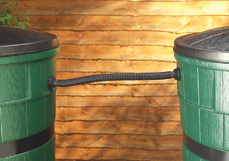
Typically the connection between two water butts is made between the high water marks of each butt as pictured above. This is because the bottom of each water butt is likely to accumulate debris (leaves etc) over time which would block the connecting tube if it were connecting the bases of the water butts.
Note that a tap is needed for each water butt in the chain.
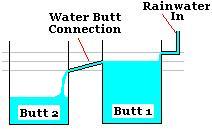
Connected in this manner (as illustrated above), when the first water butt (Butt 1) in the chain is full, water will start to flow into the second water butt (Butt 2). It is essential that the water outlet from Butt 1 is below the height of the rainwater/greywater input (arriving from the diverter), and that it is also a couple of centimeters above the water input hole of Butt 2.
Further water butts can be added to the chain in exactly the same way. Five 200 litre water butts connected in this way would give around 1,000 litres of water storage capacity for far less than the cost of one 1,000 litre water storage tank.
The majority of any debris washed down from the roof will accumulate in Butt 1 and so the water in Butt 2 will be cleaner and more suitable for use in a porous pipe irrigation system. A filter placed between Butt 1 and Butt 2 will clean up the water without any increased risk of a water butt overflowing. (If the filter does get blocked then any overflow from Butt 1 will be automatically diverted down the drain. However, if a filter between the downpipe and Butt 1 got blocked, either Butt 1 or the guttering could overflow.)
The Physical Connection Between Water Butts
The connection between the water butts can be made very cheaply with a length of old hosepipe which is then glued and silicon sealed into place. However, this is not very reliable and could start to leak. A better alternative is to purchase a dedicated Water Butt Connection Kit such as the one pictured below.
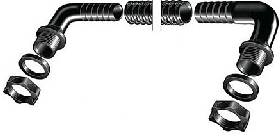
These water butt connection kits include a 1-2 metre length of very flexible hose, and all the fixtures and fittings necessary to make a secure watertight connection to each water butt – plastic bolts and rubber washers.
These kits cost from £10-15, but you could probably put one together for a bit less purchasing the individual parts from a local plumbing trade shop.
Another alternative is to purchase a couple of water butt hosepipe connectors such as those pictured below from Hozelock for under £10, fit them to the water butts, and then connect them via a length of standard hosepipe.
Comments
I connected two water butts at the bottom by replacing the taps with 22mm tank connnectors and linking together. The advantage of linking at the bottom is that water can be taken from both butts with one tap. Linking at the top requires two taps, one for each butt to kake use of the water!
Steven
May 19th 2012I have just read this article. I thought it was worth emailing you to point out an error in your article.
It is not necessary to have the inlet to Butt 2 below the outlet from Butt 1. In fact, it could be above it if you wanted. It is just necessary to make sure that the inlet to Butt 2 is below the brim of Butt 1. Ultimately the water will find the same level across all connected containers. I am guessing that you might have thought that water cannot flow uphill. It doesn’t really flow uphill; it just fills up from the bottom simultaneously with the water filling up Butt 1.
Take a look at this: Water Seeks its Own Level.
Andrew
April 4th 2012