In our article What is a Peltier Cooler we introduced the Seebeck Effect. When two different types of metal are joined together and there is a temperature difference between the two junctions, electrical current flows.
What is a Thermocouple
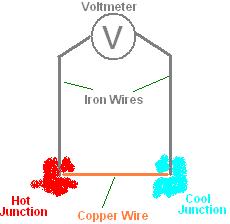
This construct of three wires, one of one type of metal and two of another type connected together as shown above is called a thermocouple and demonstrates the Seebeck effect. Thermocouples are used very widely for the measuring of temperatures – particular very high temperatures where standard liquid filled thermometers cannot be used. A precision voltmeter is used to measure the voltage generated, and from that the temperature difference betweeen the two junctions can be calculated.
If one of the junctions is kept at a known temperature – for example at zero Celcius in icy water – very accurate temperature readings can be obtained. Where accuracy is less important, this reference junction can be assumed to be room temperature. Thermocouples are very simple and very rugged since they have no moving parts.
Make a Simple Thermocouple
The thermocouples used in industry are today made very precisely with all sorts of exotic metals in order to get the required temperature range of operation and accuracy, but making a thermocouple is as simple as soldering a couple of lengths of copper wire to a paperclip!
With the first copper wire connected to one end of the unfolded stainless steel paperclip, and then the other end of the paperclip connected to the second copper wire, the two free ends of copper wire can then be connected to a voltmeter. With one junction at room temperature (a balmy 27 degrees Celcius today!), and the other junction in contact with a 220 degree Celcius soldering iron, a voltage of 1.1mV(0.0011V) was measured. Holding that junction in the flame of a cigarette lighter gave a voltage of 0.9mV.
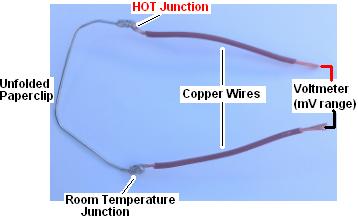
The image above shows this DIY thermocouple. Note that ideally solid core copper wire would be used, and any cable insulation must be removed, but for a quick test it did the job.
Making a Thermopile
The voltage generated by one thermocouple is not much, but if multiple junctions are connected together in series, all of their individual thermoelectric voltages will add up to make a larger more useful voltage. Again it is possible to demonstrate this with pieces of paperclip and copper wire configured as illustrated below:

Note that it is not necessary to have:
(copper – steel – copper) – (copper – steel – copper) – (copper – steel….
since the copper – copper junction can be replaced by one piece of copper giving us:
(copper – steel) – (copper – steel) ….
Ideally the central junctions should be as close to the centre of the circle as possible without touching. Sit the centre of the thermopile over a flame – for example on top of a nightlight (candle), and then measure the voltage between the two free wire ends.
With our 10 thermocouple thermopile held over the lighter flame we measured a voltage of 9.7mV. Still not very large, but easily measurable making this a nice introductory thermoelectric generators experiment.
Here is a video showing the construction and testing of a homemade thermopile: