| RSS Web Feed for Renewable Energy UK |  | REUK Shop | Directory | About Us  

Examining a Stepper Motor


Examining A Stepper Motor

Read how easy it is to understand the wiring of a stepper motor

general | education
  Printer Friendly Version Print Article     

In our article Stepper Motor Basics we explaine how a stepper motor can be used to generate electricity and how to use a multimeter to identify the wires which emerge from one.

The commonest type of stepper motor is a six-wire four-phase unit with four live AC outputs and two common outputs. In this article we will look at a small stepper motor of this type and identify the wires and build a picture of its inner workings.

The Stepper Motor


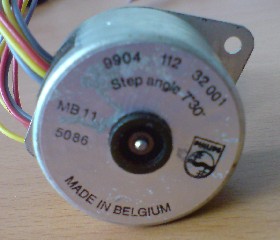
Small 48-step stepper motor

Our stepper motor is an old MB 11 sized Philips model with a 7 1/2 degree step angle. That means that it has 360/7.5 = 48 steps which means it would not be ideal for electricity generation and battery charging. As mentioned in our article Electricity with Stepper Motors it is best to choose a stepper motor with the most steps possible - usually 200 - since these motors generate higher voltages at lower RPMs; perfect for small wind turbine generators.

Labelling the Wires
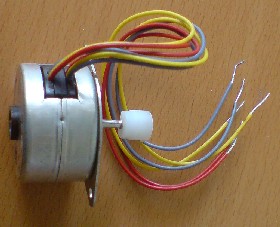

6 wires emerge from inside the stepper motor

There are six wires emerging from the stepper motor: two red, two yellow, and two grey. One red, one grey, and one of the yellow wires have a dark mark on them, the other wires are clean. Therefore we can use that to individually identify the wires. If the wires all looked the same, then we would have individually identified them with small pieces of labelled tape. We will call the wires R1, Y1, G1, R2, Y2, and G2 where the letter is the first letter of the wire's colour, and the number 1 or 2 identifies if the wire was clean (1) or marked (2).

Measuring Resistances

Systematically we connected the testing leads of the multimeter to pairs of wires coming out from the stepper motors and put the measured results into the following simple table:

 R1R2G1G2Y1Y2
R1 -117-117-
R2- -117-117
G1117- -234-
G2-117- -236
Y1117-234- -
Y2-117-234- 

All of the above results are measurements taken in Ohms. Infinite resistance is represented by a '-'.

Analysing the Stepper Motor Resistances

Where the resistance between two wires is infinite we know there is no connection between those two wires within the stepper motor - for example, between R1 and R2 or G1 and G2. We have two different values of resistance between the other wires - 117 Ohms and 234 Ohms with one being half of the other. This is because this stepper motor has four phases and therefore four identical coils. When the resistance measured between two wires is 117 Ohms, the wires are connected across one coil, and when the resistance is 234 Ohms the wires are connected across two coils.

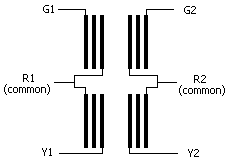
R1 is connected to G1 and Y1 across one coil. R2 is connected to G2 and Y2 across one coil. G1 and Y1 are connected across two coils, and G2 and Y2 are connected across two coils. None of the 2's are connected to any of the 1's. Therefore we can draw the following simple diagram of the wiring of this stepper motor:

Stepper Motor Wiring Diagram

Our four live wires are G1, G2, Y1, and Y2, and there are two common wires R1 and R2. We now know everything we need to know to rectify the output from this small stepper motor into DC electricity for battery charging or to light some LEDs.


Article Last Modified: 08:58, 24th Mar 2007

Comment on this Article

If you have any comments on this article, please email them to neil@reuk.co.uk.


Recommended Related Articles

People who read this article also enjoyed the following articles:

Stepper Motor Basics
Learn more about stepper motors and their use in RE electricity generation
Article Last Modified: 08:54, 4th Apr 2007
wind | education

Electricity with Stepper Motors
Find out the basics of generating electricity with stepper motors
Article Last Modified: 16:07, 10th Jun 2008
wind

Smoothing Capacitors
Find out more about the uses of smoothing capacitors in renewable energy circuits
Article Last Modified: 10:47, 4th Apr 2007
electric circuit | education

Bridge Rectifier
Find out more about bridge rectifiers.
Article Last Modified: 15:33, 2nd Feb 2007
electronics | wind | wave

Stepper Motor Voltage Doubler Circuit
Double the voltage from a stepper motor using two bridge rectifiers
Article Last Modified: 09:45, 9th May 2007
general | electric circuit | education

Permanent Magnet Generator
Build a wind or water power system with around a PM Generator
Article Last Modified: 15:43, 6th Apr 2010
wind | hydro

Make A Bridge Rectifier From Diodes
Make your own single or multi phase bridge rectifier from diodes
Article Last Modified: 15:33, 2nd Feb 2007
wind | electric circuit

PVC Wind Turbine Blades
Learn how to make your own PVC wind turbine blades
Article Last Modified: 14:16, 19th Aug 2008
wind

Photos of PVC Wind Turbine Blades
Photographs of PVC wind turbine blades
Article Last Modified: 13:09, 22nd Dec 2006
wind

Making Voltage Doublers and Multipliers
Find out how to construct an AC voltage doubler circuit. Extend it to a tripler circuit and more.
Article Last Modified: 13:29, 26th Apr 2007
electric circuit | education

© 2006-2012 REUK - All Rights Reserved
Page Last Updated on 4th February 2012 at 12:42:53pm

Latest
Articles


Make a PICAXE Repeating Timer
Make your own repeating timer with our automatic PICAXE Basic code generator
education
12:42, 4th Feb 2012

Karasouli SCC 20 Wind Turbine Charge Controller
Find out more about the SCC-20 wind turbine charge controller and dump load controller
wind
12:42, 4th Feb 2012

UK Feed in Tariff to be Cut by 50 Percent
UK government announces 50% cut in feed in tariff payable on new solar PV installations
solar
12:42, 4th Feb 2012

PIR Sensor Circuits
Find out more about using PIR sensors within renewable energy applications
electronics
12:42, 4th Feb 2012

Water Heating with Surplus Solar PV
Heat water with surplus solar generated electricity
solar
10:58, 4th Feb 2012

Hacked PIR Sensor
Cannibalise a cheap PIR sensor to put it to other uses
electronics
10:44, 4th Feb 2012

Make a Still
Find out how to make your own still for distilling ethanol fuel
biomass
13:49, 31st Jan 2012

PICAXE Microcontrollers
Find out about PICAXE microcontrollers and their use in renewable energy projects
electronics
13:12, 30th Jan 2012


REUK Shop

Popular Items


REUK SUPER LDR DUSK DAWN RELAY CONTROLLER
Multi-function light detector triggered light/dark dawn/dusk relay controller
£18.95 each.
Complete Circuits


KARASOULI SCC 20 CHARGE CONTROLLER
20A rated wind turbine charge controller and dump load controller with blocking diode and heatsink
£43.95 each.
Renewable Energy System Parts


SOLAR PUMP CONTROLLER WITH RELAY
Solar water heating system microprocessor controlled circuit with fitted 10A relay
£25.99 each.
Complete Circuits


REUK SUPER POULTRY LIGHTING CONTROLLER
Control up to 8 Watts of LED spotlights to stimulate egg production in birds
£29.99 each.
Complete Circuits


REUK SUPER TIMER 2
User programmable 12VDC powered 16A rated repeating relay timer. 1 second to 99 hours ON and OFF times
£23.99 each.
Complete Circuits


300 WATT POWER INVERTER
Convert 12V DC battery power into 230 AC to power portable televisions, computers, video recorders etc. 300 Watt power rating - peak power 600 Watts
£29.99 each.
Renewable Energy System Parts


CONVERTED PROGRAMMABLE DIGITAL TIMER RELAY
Mains powered programmable timer converted to low voltage with relay board
£21.99 each.
Renewable Energy System Parts


12 VOLT REGULATOR
Supply a fixed 12.0 Volt DC to your devices (up to 1 Amp output)
£4.99 each.
Complete Circuits


MR16 CERAMIC BULB HOLDER
Bulb holder for 12 Volt LED spotlight bulbs
£1.39 each.
Energy Efficient Lighting