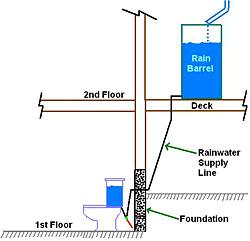
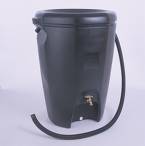
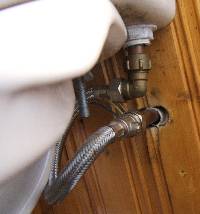
I have recently come across your article regards flushing toilets with rainwater. I found this most enlightening and I applaud your efforts to educate the public. I cannot agree more that we all need to consider how mains water is used and should consider all opportunities in reducing the excess waste that often happens. http://www.reuk.co.uk/Flush-Toilet-with-Rain-Water.htm
However the reason we treat water to the high quality we do is to ensure public health is not harmed in any way when drinking water is supplied to customers. I do find myself at odds with the advice given in this article, the type of installation you describe here does pose risks to the users and would be in breach of the Water Fittings Regulations in a number of ways.
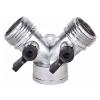
I am sure you are aware that harvested rainwater has the potential to contain pathogens and it is for these reasons it is categorised as a fluid category 5 fluid in the Water Fittings Regulations. This is what causes me some concern because your advice includes the suggestion that a Y connector could be used to allow 2 feeds (one rainwater and one drinking water) to be coupled to the one toilet ball valve.
Under these Regulations to ensure that the rainwater cannot get back into the drinking water, backflow protection to fluid category 5 must be installed. At this level of protection the Regulations would not allow any mechanical protection device to be used, such as check valves, and that the use of a physical air gap is needed. Therefore a direct connection via a Y piece is not possible.
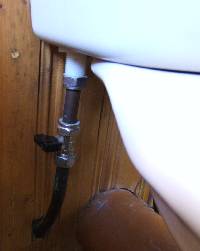
Also the picture shows a ball valve supplied from the bottom of the toilet cistern that will be in direct contact with the rainwater. These types of ball valve only have on layer of material between the drinking water contained in the ball valve and the rainwater in the toilet cistern, UK Regulations are based on European standards (BS EN 1717) which require that there be 2 layers of material between these two fluids (known as double wall separation), also that a fluid category 5 air gap is also included between the discharge point from the drinking water valve and the spill over level of the rainwater be maintained. The toilet cistern shown does not have this type of protection. Within the water industry we fully understand the need to ensure toilets have a continuous supply, due to the health implications, but have yet to find a toilet manufacture that include this necessary air gap arrangement.
We have produced guidance for rainwater harvesting systems, which you may find of some use and is free to access on our website ( http://www.anglianwater.co.uk/_assets/media/Water_reuse_systems_VERSION_3(1).pdf ).
As we are charged in enforcing the Water Fittings Regulations I must ask that you amend your guidance so it does not give misleading advice that, if followed by customers, would leave them open not only to a potential contamination route for their drinking water but also to prosecution for non-compliance with the Water Fittings Regulations, which might ultimately lead to a criminal conviction if it was upheld.
Paul Millard
Water Supply Regulations Manager, Anglian Water Services Ltd
3rd October 2011
I have been using a rainwater toilet flush system for the last year and a half. My water bill has gone from £34/month to £9/month. I have found that a standard Whale caravan submersible pump works great, 12volt 2.3 amps (with a non return valve, as they are centrifugal pumps).
I pump water from a distance of 13 meters away and then up 4 meters. The rain water enters the house via the overflow pipe along with a 2 core cable and into the cistern. The cable connects to a tamper switch from an alarm box lid. The lever of the switch touches the float arm in the cistern (so the loo fills automatically when the level drops and stops when full). Power comes from an old car battery charged for 15 minutes every day. I dont need the overflow pipe anymore as i have fitted a flap type flush mechanism with its own ‘internal overflow’. I dont have a level switch on my barrel as yet, but have a toggle switch in series with the tamper switch, so after flushing if there is no rainwater splashing down in the cistern I lift the lid off the cistern and turn off the pump/rainwater circuit, then i go back to mains water by turning on the isolation valve under the cistern. Its very simple and there is no way of contaminating mains water as it is protected by a valve and the level in the cistern cannot come into contact with the mains filling pipe due to the overflow drain.
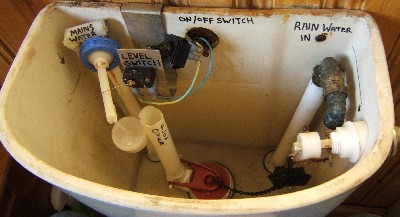
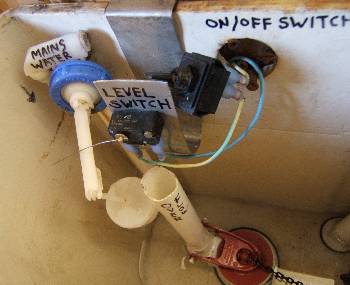
Pictured below are the mains water (left) and rain water (right) pipes feeding the cistern. Note the isolating valve on the mains water feed which is usually left as shown in the closed position, but can quickly be opened manually if the rainwater supplies run down. The hole in the wall through which the rainwater feed passes also permits the low voltage (12VDC) cables through to the cistern:
Peter, 24th January 2010
A query – in your description of the rainwater toilet you describe a valve that will allow a change from Rainwater to Tap water- a brass hosepipe splitter. I dont think this is legal because as you point out in the pumped version there has to be an air gap of 150mm where Tap water and rainwater meet? I am sure that the splitter contravenes the water bylaws.
I note that you list in your section on cistern displacement devices a bottle filled with sand. I have such a system but I have filled my bottle with water which is easier and cheaper. I used to be involved in Water Conservation when I worked for a Water Company and we advocated water bottles. A study I started (but didn’t finish as I retired) was looking at double flushing which resulted from putting bottles in cisterns. The bottles are only effective when there is some design redundancy in the bowl. ie some bowls need 13 litres to flush everything away. If double flushing occurs then reduce the volume of the displacement device otherwise you may use more water. Better still get a replacement dual flush siphon. Keep saving
Paul
December 3rd 2008