Geothermal heat pumps (aka ground source heat pumps) take advantage of the relatively constant temperature of the ground as a heat source and a heat sink to provide both heating and cooling for homes and offices. A liquid refrigerant is pumped from the outside to the inside carrying heat from one area to the other in much the same way that a refrigerator works – i.e the fridge is cold outside, but the back of the fridge is hot (heated by the warmth removed from inside).
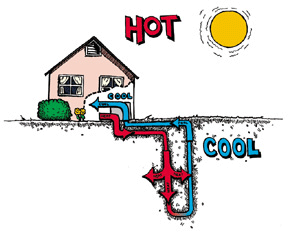
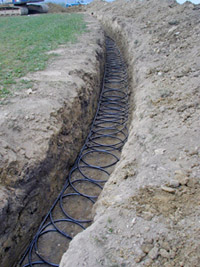
There are three basic alternative geothermal heating systems – vertical, horizontal, or open loop. In a vertical system a deep hole is drilled (30m or more) taking the loop of pipe to a thermally stable zone. In a horizontal system excavations are only down 4 or 5 feet and so more of the surface of your land needs to be excavated, but it is easier and therefore cheaper to achieve (see image below).
Typically a vertical system is more likely to be used where the the climate is extreme and hence where the near surface temperature of the ground is not constant. An open loop system is used sometimes used where a home is served by its own well, pond, lake, and/or river. The water used as a heat source or heat dump is then drained to another well to be used for drinking and washing etc.
To heat (or cool) your home with geothermal energy you need a heat pump unit (condenser outside and evaporator coil inside), a loop of refrigerant filled piping buried outside, ductwork inside, a circulating pump, and other mechanical and electrical items which complete the system. Though initially expensive, ground source heat pumps are very cheap to run and maintain, and they are also very efficient and environmentally friendly. However if saving money is your concern, paying for the installation of your heat pump system through a mortgage will actually lose you money.
Geothermal heat pump systems work best with underfloor heating rather than radiators since the underfloor heating operates at a much lower temperature than radiators in order to heat the air of a room to the same temperature.
More Information on Heat Pumps
NEWFor more information on the workings of heat pumps, take the time to read our new article Air Source Heat Pumps. Also, an excellent article about Heat Pump Mechanics can be found here.
Comments
|