| REUK Shop | REUK Blog | Directory | About Us  |  | RSS Web Feed for Renewable Energy UK 

Grid Tie Inverters


Grid Tie Inverters

Find out more about Grid Tie Inverters - connect your RE system to the grid

general | wind | solar | electronics
  Printer Friendly Version Print Article     

For a brief summary of power inverters and their use in a renewable energy system please read our Introduction to Inverters.

If you have a small scale renewable energy set up - for example, just a micro wind turbine or a few PV solar panels, then you will almost certainly be using battery storage rather than tying into the National Grid. In those cases there are very many suitable inverters ranging from just £10 to many £hundreds depending on your exact needs. If however you wish to connect your wind turbines and/or solar panels to the National Grid, you will need a Grid-tie Inverter - particularly if you intend to sell (export) electricity back to the utility company.

Grid-Tie Inverters (plug in type)

Not all grid-tie inverters operate in the same way. In general a grid tie inverter needs to be wired directly into your home electric circuit by a qualified electrician. However a simpler alternative has been on the rise recently - an inverter which you simply plug into a home ring main using a standard three pin plug. This is exactly the type of power inverter provided with the no longer available Windsave 1000 wind turbine.

If for example you have a laptop computer and a desk lamp drawing around 150 Watts between them, and a solar panel generaing 200 Watts which is plugged into the same ring main using a plug-in inverter, then the laptop and lamp would be powered entirely by your solar panel and any excess power would be lost to the National Grid. If you only had a 100 Watt solar panel, then its power would be supplemented by the National Grid (and you would have to pay for the extra electricity used).
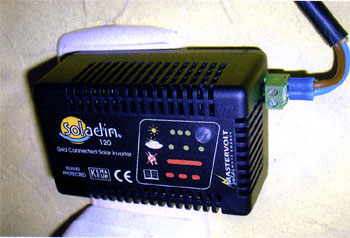
Mastervolt Soladin 120 Plug In Mini Inverter

If you have a small DIY renewable energy set up, then a plug in inverter such as the Mastervolt Soladin 120 pictured above is a good starting point. This tiny plug-in inverter will accept up to 2.8A and 50V DC with a nominal power output of up to 90 Watts. It converts the DC into 230 VAC at 90+% efficiency. (12V solar panels would have to be put in series to generate 24 Volts since the voltage range for this inverter starts at 24 VDC.) It is priced at around £100.
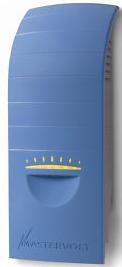
Mastervolt Soladin 600 grid tie inverter

For larger solar systems, the excellent Soladin 600 - the world's smallest mini string inverter pictured above is a good option. Taking its input from 160 to 700 Watts of solar PV at a voltage of 40-125 VDC, the Soladin 600 will output up to 525 Watts of 50 Hz mains voltage electricity. This inverter is rated at over 91% efficiency and it is MCS, FIT, and G83/1 approved for plug and play UK use.
Click here for more information and/or to purchase the Soladin 600 Grid Tie Inverter for from £300. It is supplied with a mounting bracket and a 5 year warranty. Click here to download the Soladin 600 Instruction Manual (PDF).

NEW - Cheap Chinese designed and built plug in grid tie inverters are now available here at well under £100 for a >300 Watt unit: grid tie power inverter.
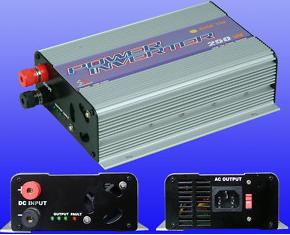
Cheap Chinese plug and play grid tie solar power inverter


Large Grid-Tie Inverters

Large grid-tie inverters are generally one of the most expensive components of a renewable energy generation system. Typically prices start from at least £500 going up to £thousands, but prices are falling as the technology improves and PV installations become more common place.
Manufacturers of quality grid-tie inverters include: ExelTech, Fronius, Magnum Energy, Morningstar, Outback, SMA, Solectria, and Xantrex.
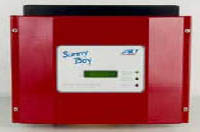
Sunny Boy SWR2500U Grid Tie Inverter

Probably the most popular are the Sunny Boy series of grid connecting inverters from SMA - a German company specialising in inverters for solar generating applications. All Sunny Boy inverters comply with UK G83 grid connection regulations, have efficiencies of over 93%, and have an estimated lifetime of over 20 years.

The SB700 is available in the UK for around £800 offering up to 700 Watts of power. Much larger applications could be served with an SB3000 or SB6000 inverter for powers of up to 3000 (£1500) and 6000 Watts (£2500) respectively. And of course there are Sunny Boy's with many other power outputs within that range.

Click here for best prices on the full range of Sunny Boy Inverters in the UK.


Article Last Modified: 13:37, 9th Mar 2011

Comment on this Article

If you have any comments on this article, please email them to neil@reuk.co.uk.

Andrew has noted the danger of using a standard IEC pinned connector for power out. However, using the chassis-mounting socket connector doesn't actually help either, as the lead plugged into this will end in a BS1363 plug, if it is for plug-and-play use, and this will still give exposed live terminals when not plugged in.

Unless it can be proven (using an oscilloscope and appropriate caution, not your fingers!), that the "island protection" feature of the inverter reacts fast enough to removal of the plug to protect the user, this would cause a hazard to manifest. Irrespective of infringement of regulations (which I do not condone), a permanent connection from the inverter to a spur box would then appear to me to be the minimum necessary to avoid a significant risk of electric shock.

Note, however, that it is not the same as exposed terminals on a mains outlet. In the case of these inverters, the user would have to touch two conductors simultaneously and current will flow between them, as there (should be) no path to earth because the inverter is isolated. I say "should be" because most small inverters will not themselves be isolated, being switch mode devices, so the isolation relies on the input side not being connected to ground.

Using a chassis connector on the inverter would be more dangerous, as unplugging the mating connector with the BS1363 plug in the socket would result in exposed mains at the IEC pins, with only the consumer unit RCD to protect you - not nice!

Mark
4th March 2012


I've had one (it's the same as your picture, but branded differently) connected to a solar panel for a year or so.
I don't know much about electronics, but these are my thoughts
- It has a rather optimistic hand printed 'ROHS' and 'CE' approval sticker on it
- It came with a moulded 3 pin plug - with no fuse
- According to my Killawatt it takes no power whilst not generating
- It produces 0 Watts until the solar panel is producing > 14V
- On a sunny day I see readings of about 20 Watts from my 30 Watt solar panel
With respect to a comment Andrew regarding the pins being live, I don't think they are.

The manual made mention of 'island' mode, in pseudo English, indicating that unless an AC phase is detected on the output, the input stage stays disconnected.

In short, it has all the hallmarks of a good design, ripped off and churned out by the thousand on a production line in east Asia.

I think, for £60 it's great.

Gary
Feb 24th 2012


There seem to be numerous reasons why plug and play [inverters] are not allowed in the UK, not least- BS7671:2008 (amd 1, 2011) 551.7.2 (ii) A generating set shall not be connected to a final circuit by means of a plug and socket. If you have any references which refer to permission for plug and play please let me know.
The Windsave system to which you refer was originally advertised as plug and play, but as I understand it they did change this connection to a dedicated fused connection unit on a spur or ring final circuit. However more recent regulations require the use of an appropriate RCD for any such connection, as well as an assessment of the suitability of the existing circuit in regard of disconnection times etc, which puts connection outside the scope of consumer plug and play.

Matt, 19th December 2011


It is my belief that these [Chinese grid tie inverters] are, not to put to fine a point on it, really dangerous. You will note from the picture [3rd in this article] that there are pins protruding from the unit on the 240v side that are unshielded. So, if a person connects their panel to the inverter and manages to touch the pins they will receive a 240v shock at quite a number of amps. Certainly enough to hurt, possibly enough to kill the frail.

If you take a look at this image [of a PC power supply]: you will see that the output side has a moulded plastic shield preventing you from touching the pins.

Andrew, 6th June 2011


Recommended Related Articles

People who read this article also enjoyed the following articles:

Giromill Darrieus Wind Turbines
What is a Giromill wind turbine - Darrieus (VAWT)
Article Last Modified: 16:27, 30th Jan 2007
wind | education

Buy a VAWT Vertical Wind Turbine
Understand the advantages and disadvantages of VAWTs
Article Last Modified: 10:37, 26th Oct 2010
wind

Permanent Magnet Generator
Build a wind or water power system with around a PM Generator
Article Last Modified: 16:43, 6th Apr 2010
wind | hydro

Calculation of Wind Power
Calculate the power of the wind hitting your wind turbine generator
Article Last Modified: 15:06, 18th Apr 2008
wind | education

Calculate kWh Generated by Wind Turbine
Knowing average wind speed and rotor size of a wind turbine estimate kWh of electricity generated per year
Article Last Modified: 15:58, 8th Mar 2007
wind | education

Quiet Revolution QR5 VAWT
Find out about the QR5 Vertical Axis Wind Turbine from Quiet Revolution
Article Last Modified: 09:47, 20th Dec 2006
wind

Real Time Wind Speed Map
Check current wind speeds at your UK location and see a forecast for the next 7 days
Article Last Modified: 15:19, 18th Jan 2007
wind

Switch from Inverter to Mains Automatically
Power a circuit directly from a power inverter, but with automatic mains power back up.
Article Last Modified: 11:16, 28th Nov 2012
electric circuit | storage | general

Windsave 1000
Find out more about the Windsave 1000 system
Article Last Modified: 10:21, 9th Mar 2011
wind

Cheap Pyroelectric Infrared PIR Detector
Details of a very affordable and flexible PIR motion detector
Article Last Modified: 20:33, 16th Jan 2013
electronics | education | electric circuit

© 2006-2013 REUK - All Rights Reserved
Page Last Updated on 19th May 2013 at 08:29:13pm

Recent
Blog Posts


1.Offer of the Day – 80W Monocrystalline Solar Panel £71.98

2.Project of the Day – Wind Turbine Dynamic Blade Pitch Controller

3.Morocco Starts Vast Solar Energy Project

4.Follow Up to RC Helicopter Lighting Controller

5.Low Voltage Disconnect – User Programmable Set Points in Binary

6.UK Home Energy Smart Meter Project Delayed

7.EU to Impose High Import Duties on Chinese Made Solar Panels

8.Project of the Day – Swimming Pool Solar Water Heating Controller with Max Temperature

9.Multiple Buttons/Switches on one ADC Input

10.Standalone Arduino on a Breadboard


Latest
Articles


New Simple Hen House Door Controller
Details of our new 2013 simple design for an automatic hen house door controller
electric circuit
11:45, 20th Apr 2013

Automatic Hen House Door Closer Opener
Find out how to put together a DIY automatic hen house door opener and closer
electric circuit
11:40, 20th Apr 2013

Butanol vs Ethanol Fuel of the Future
A brief introduction to Butanol/Biobutanol as an alternative to Ethanol
biomass
11:55, 19th Apr 2013

Cheap Pyroelectric Infrared PIR Detector
Details of a very affordable and flexible PIR motion detector
electronics
20:33, 16th Jan 2013

Heat Pump Tumble Dryer
Reduce power consumption with the latest heat pump tumble dryer technology
energy efficiency
20:16, 3rd Jan 2013

LED Spotlights
Find out about Energy Efficient LED spotlights
lighting
15:17, 3rd Jan 2013

Dimmable Energy Saving Lightbulbs
Find out more about low energy light bulbs which can be used with standard dimmer switches
lighting
14:36, 3rd Jan 2013

Review of Megaman Energy Saving Lightbulbs
Find out more about the Megaman range of CFL energy saving lightbulbs
lighting
14:08, 3rd Jan 2013


REUK Shop

Popular Items


REUK SUPER LDR DUSK DAWN RELAY CONTROLLER
Multi-function light detector triggered light/dark dawn/dusk relay controller
£19.95 each.
Complete Circuits


KARASOULI SCC 20 CHARGE CONTROLLER
20A rated wind turbine charge controller and dump load controller with blocking diode and heatsink
£43.95 each.
Renewable Energy System Parts


2013 SOLAR PUMP CONTROLLER WITH RELAY
New solar water heating pump controller with fitted 10A relay
£25.99 each.
Complete Circuits


REUK SUPER POULTRY LIGHTING CONTROLLER
Control up to 8 Watts of LED spotlights to stimulate egg production in birds
£29.99 each.
Complete Circuits


REUK SUPER TIMER 2
User programmable 12VDC powered 16A rated repeating relay timer. 1 second to 99 hours ON and OFF times
£23.99 each.
Complete Circuits


300 WATT POWER INVERTER
Convert 12V DC battery power into 230 AC to power portable televisions, computers, video recorders etc. 300 Watt power rating - peak power 600 Watts
£29.99 each.
Renewable Energy System Parts


CONVERTED PROGRAMMABLE DIGITAL TIMER RELAY
Mains powered programmable timer converted to low voltage with relay board
£21.99 each.
Renewable Energy System Parts


12 VOLT REGULATOR
Supply a fixed 12.0 Volt DC to your devices (up to 0.7 Amp output)
£4.79 each.
Complete Circuits


MR16 CERAMIC BULB HOLDER
Bulb holder for 12 Volt LED spotlight bulbs
£1.39 each.
Energy Efficient Lighting