Good ventilation is very important in a home if cooking smells, excess humidity from bathing and washing are to be removed, and if the air is to remain fresh and free of pollutants. In many modern homes with thick insulation and double-glazing, the old ‘problem’ of draughts has been replaced with the sometimes worse problems of condensation, mould build up, and stale air.
Most bathrooms and kitchens are fitted with extractor fans to get rid of steam and smells, but these simple suck moist air (that has been expensively heated) out of the house, and suck cold dry air in through the small gaps in the fabric of the building and window trickle vents. In warmer climes where air conditioning is prevalent, expensively cooled air goes out of the extractor to be replaced with hot air from outside. This is obviously very inefficient.
Heat Recovery Ventilation
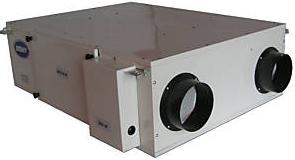
Heat recovery ventilation (HRV) also know as mechanical heat recovery ventilation (MHRV) describes equipment which gets fresh air into a building while ensuring the temperature of the air flowing back in is the same as that flowing out.
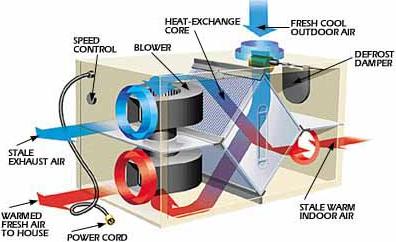
Pictured above is a schematic of a typical heat recovery system (from Popular Mechanics). In the centre is a heat exchanger – a unit with a very large surface area thanks to its construction of interconnected thin metal plates.

As the warm stale air moves through this heat exchanger, the metal is warmed up rapidly removing the heat from the air. When the cool fresh air then moves through the heat exchanger in the opposite direction, the heat in the metal is transferred to the fresh air warming it up. By the time the stale air leaves the unit and is exhausted outside its temperature is close to that of the outside, and the fresh air being pushed into the building is at a temperature close to that of the inside. This is the process of heat recovery in practice. A typical heat recovery system will recover 70%-80% of the heat that would otherwise be lost to the outside.
A heat recovery system has two fans – one to suck the old stale air out, and one to drive fresh air in. These do not use a lot of electricity (typically < 50 Watts for a 4 room unit up to 100 Watts for a unit for a very large house) and so good energy (and money) savings can be made thanks to the reduction in heating bills. Many HRVs are also fitted with washable pollen and dust filters similar to those found in cars.
HRVs are at their most useful in the winter months when the air inside a building is at its most humid – not a good thing since it takes more energy to heat moist air than it does to heat dry air – and the air outside is at its coldest. For very cold climates, HRVs with a thermostatically controlled heating coil (typically rated at around 300 Watts and turned on only when external ambient temperature is below -5 Celcius) are available which prevent frost building up on the exterior side of the heat exchanger.
In coutries where it is very humid outdoors, an ERV is instead used. This is an energy recovery ventilator which is the same as an HRV, but with a built in dehumidifier to strip moisture from the inflow of fresh air.
Buy a Heat Recovery System
Heat recovery systems can be purchased in a range of different sizes to meet different requirements. Most are designed as whole house HRVs with one unit containing the fans and heat exchanger designed for wall, ceiling, or loft fitting supplied together with room inlets, room outlets (so that fresh air can be directed into and out of the key rooms such as bathrooms, kitchens, and utility rooms etc), insulated ducting, and external wall grills for the fresh air inlet and stale air outlet.
Whole house heat recovery systems are sold with the floor area of the house as the size. Typical (competitive) prices (including all the necessary bits and pieces) are around £600 for 1200 sq ft, £900 for 2500 sq ft, £1000 for 3000 sq ft. Click here for a selection of the best priced Heat Recovery Systems.
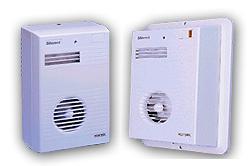
For individual rooms, heat recovery extractor fans are also available for as little as £50, but typically £120-160 for a good quality unit such as the Silavent ENX100HRT pictured above.
Vent-Axia also sell an excellent whole house heat recovery system for which the instruction manual is available to download. Click here for that, technical information, and/or to make a purchase: Vent-Axia Heat Recovery Unit.
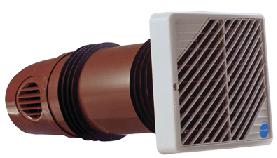
Pictured above is another single room heat recovery extractor fan, also from Vent-Axia, and available here: Vent-Axia LoWatt HR25, and often cheaper here.