Voltage regulators are available as easy to use three terminal integrated circuits – one terminal for the input voltage, one for the output voltage, and one for the ground (0V). The most commonly used are from the 78XX series – 7812 for 12 Volts, and 7805 for 5 Volts etc. Also of particular use for renewable energy generators are very efficient low dropout regulators such as the LM2940 series – LM2940CT-12 for 12 Volt etc.
One common shortfall of these common regulators is they are rated at just 1 Amp output current. It is usually possible to use them with higher currents, but a large heatsink and/or fan is essential. Regulators for higher currents than 1 Amp are available, but tend to be expensive, and still require good heatsinking.
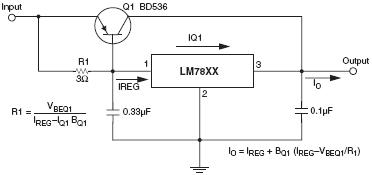
Pictured above is a circuit from the Fairchild LM7812 datasheet. This uses a power transistor and apower resistor to take on some of the workload enabling higher currents to be regulated. With this set up, the power transistor and power resistor need heatsinking, and selecting the correct specification of transistor and resistor, and getting everything set up is not particularly easy.
One alternative is instead to parallel connect multiple three terminal regulators, with each regulator handling up to 1 Amp of current.
Parallel Connecting Mulitple Voltage Regulators
Voltage regulators such as the LM7812 cannot just be connected in parallel without additional circuitry. Each voltage regulator, though nominally rated at the same voltage, will in practice output a slightly different voltage – for example, three LM7812’s could output 11.98, 12.01, and 12.06 respectively.
This tiny difference in voltage has the disastrous consequence of making the regulator with the lowest output voltage trying to carry all of the current. This will cause it’s internal thermal protection to trigger (as the regulator overheats) effectively removing that regulator from the circuit and kicking off a chain reaction up through the remaining parallel-connected regulators.
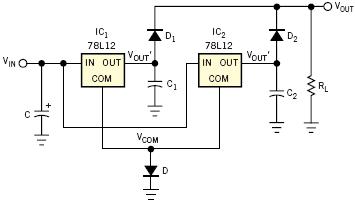
The circuit shown above* (from the EDN article High-Current Supply uses Standard Three-terminal Regulator) has two LM7812 voltage regulators connected in parallel for a maximum total output current of 2 Amps – double the rated current of one LM7812.
* Diodes D1, D2, and D should be 1N4007 according to the EDN article, but common 1N4001 diodes will be fine as they are rated up to 50V which is more than enough. The capacitors are supposed to be C=47,000uF, C1 and C2 are 4,700uF, but as a 47,000uF capactitor is expensive and physically very large we tested this regulator using a 4,700uF for C, and 1,000uF for C1 and C2 and had no problems.
An even simpler way to parallel connect multiple voltage regulators together is to add very low (below 1 Ohm) ballast/equalising resistors in series with the regulator outputs. Doing so should make the regulators share current equally and therefore operate together without problems. It is worth noting however that this approach to load balancing makes the voltage regulation a bit less accurate.
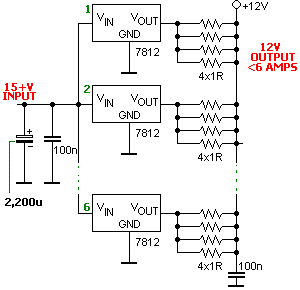
An example of this simplistic approach in use can be seen in the above experimental 12V 6A power supply* in which six LM7812 regulators were connected in parallel with 0.25 Ohm load balancing resistors (made up of four 1 Ohm resistors in parallel) connected in series with the output from each 7812 regulator. The schematic shows the key elements in this 6 Amp 12 Volt regulator.
* The original circuit diagram was published on the Wroclaw University of Technology website back when we first published this article in 2006/7. Unfortunately that article is no longer online.
High Current Variable Voltage Regulation
Where you need to have a user variable voltage output, the LM317 is an excellent adjustable voltage regulator to use. The output voltage is adjusted using a couple of resistors, and one of these resistors can be replaced with a potentiometer to give an adjustable output.
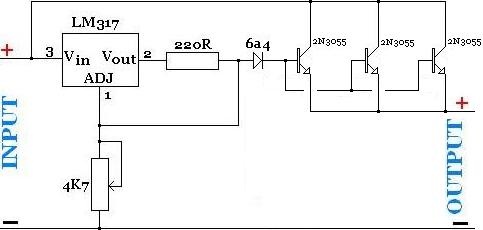
While the LM317T for example is limited to a continuous output of 1-1.5A subject to sufficient heatsinking, one or more power transistors can be added as shown above to make an adjustable high current power supply. Click here for full details: LM317 Adjustable Power Supply.
Comments
| Hello from Kentucky USA!
In regard to this page, I have drawn up a couple of 78xx high current circuits you might like to consider. I’ve used them for a 30amp power supply with a 7815 regulator. 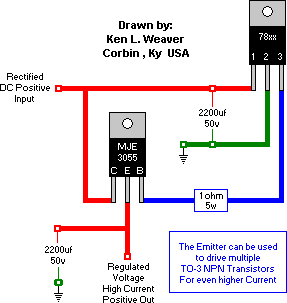 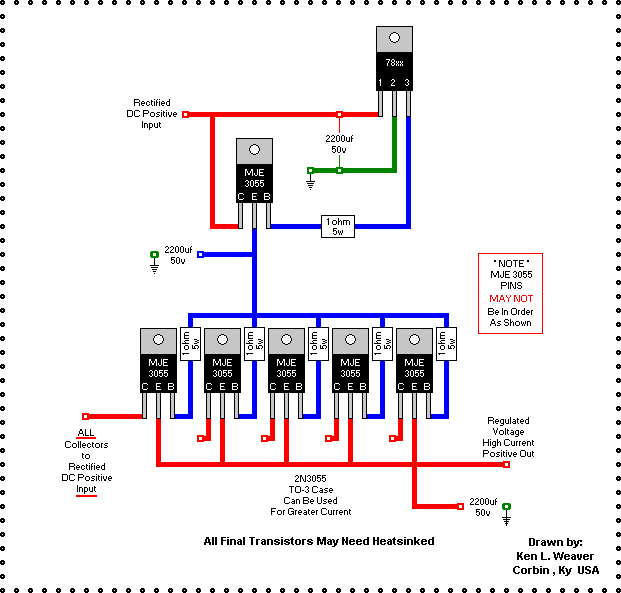 REUK Added Info: The MJE3055 is an NPN silicon power transistor rated at up to 60V, up to 75 Watts, and up to 10 Amps. Click here to view the MJE3055 Datasheet for more information. I have since switched to using the better LM723 regulator so that I can adjust the voltage and it is far more reliable than the 78xx. I have used the LM723 for a 105amp supply. REUK Added Info:The LM723 is a voltage regulator rated for outputs of 150mA at an adjustable voltage from 2V to 37V. By adding transistors as shown in the schematics above high output currents at the regulated voltage can be output. Click here to view theLM723 datasheet. I’ve learned a few things on your site so I thought I’d pass along a little in return. Ken Weaver, 17th August 2009 The benefit of this first schematic is that the output is actually regulated; the PNP is fully in the feedback loop. Nick, 10th July 2012 |