Pictured below is the new (December 2011) SCC-20 wind turbine charge controller with integrated dump load controller from Karasouli. This is a new low cost, highly efficient, and easy to use charge controller designed for domestic and small commercial micro-generators.
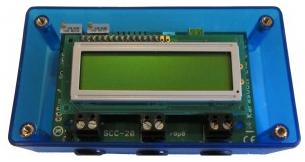
What is a Wind Turbine Charge Controller
If a wind turbine generator is connected directly to a battery (or battery bank), there is always the danger that the battery will be overcharged and permanently damaged. During heavy winds when the battery is already nearly fully charged, the battery voltage will increase to such a level that the battery is unable to store more energy. Beyond this point any further energy sent into the battery by the turbine will result in gassing – the breakdown of the electrolyte solution in the battery releasing oxygen and hydrogen gas from the battery vents. This is not something you want to happen!
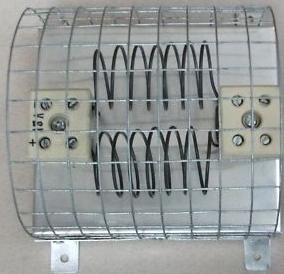
In order to protect the battery, a wind turbine charge controller is used. This device continually checks the battery voltage, and when it is found to have reached a user-set top charge point (just below the gassing voltage), power is diverted from the battery to a dump load – e.g. a heater or large resistor – which prevents overcharging and protects the battery. (Click here to find out more and/or to purchase a suitable dump load such as the 600W rated unit pictured above).
SCC-20 Charge Controller
The SCC-20 is designed to be very simple to set up, configure, and use, but to work very efficiently.
A typical wind turbine charge controller will have two voltage points that the user has to set. The first is the upper voltage above which they would like the wind turbine power to be diverted to the dump load; the second is a lower voltage at which they would like the dump load to be turned off again and for the wind turbine to send its power to the battery. Why two voltages? Because of the problem of cycling.
The charge controller measures the voltage of the battery and finds it to be at the upper limit. It therefore turns on the dump load which pulls down the battery voltage so that the next time it is measured, it appears that the battery is no longer overcharging and the dump load is turned off again. The voltage then immediately jumps back to the upper limit as the battery no longer has a load connected to it, so the dump load needs to be turned on again!
There is a relationship between the size of the dump load chosen and the difference between the upper and lower voltages, and with traditional charge controllers it can be very tricky to get everything configured for reliability and efficiency.
To avoid the above mentioned problems, SCC-20 uses a PWM algorithm which sends just the right amount of power to the dump load when necessary while keeping the battery voltage stable (floating at full charge). Very simply the “PWM” means that the dump load is turned on and off rapidly many times per second so that some power is sent to the dump load and some to the battery. By constantly measuring the battery voltage and constantly adjusting the ratio of power going to the battery and to the dump load this is a very efficient controller. Also, the user only has to set one voltage, and can use any dump load capabable of dissipating the maximum power output of the wind turbine which is easy.
SCC-20 is supplied ready for a 12 VDC lead acid battery system with the maximum charge voltage preset to 14.8V. This can be changed if required by turning an adjustment screw until the ‘set voltage’ shown on the SCC-20 digital display is as desired. SCC-20 can be used as is with a 24V battery system. The user just needs to change the ‘set voltage’ to somewhere around 29.6-29.8V for lead acid batteries.
SCC-20 has a couple of LEDs which are used to show the current state of the system, and this information is also given by the digital display which shows the battery voltage, set voltage, and state.
SCC-20 is rated at up to 20 Amps which corresponds to a wind turbine rated at up to 300W (maximum power) for a 12V battery system, or up to 600W for a 24V battery.
Blocking Diode
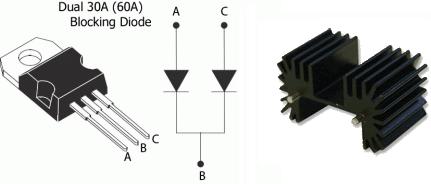
Many wind turbine charge controllers are fitted with integrated blocking diodes. This component permits current from the wind turbine to flow into the battery, but does not let the battery send current to the wind turbine (which would cause it to motor – i.e. run backwards under battery power). A lot of heat can be generated by the diode when it is very windy, and it can be hard to manage the dissipation of this heat when the blocking diode is fitted in the box with the controller. Therefore SCC-20 does not come with an integrated blocking diode, but the manufacturers of the product offer this handy guide to blocking diode and heat sink selection: Blocking Diodes and Heat Sinks (PDF), and also sell a suitable blocking diode and heat sink.
More Information and Buy SCC-20
To find out more about SCC-20 and whether it will meet your particular needs, click here to view the SCC-20 User Manual (PDF)
SPECIAL OFFER – We have limited stocks of SCC-20 available as a package WITH a 60A blocking diode AND a matching heatsink for just £43.95 – a special discount of over 20%. Click here to buy Karasouli SCC-20 REUK Package now from REUK.co.uk.
SCC-20 (£44.95), blocking diodes (£4.95-£5.95), and heat sinks (£4.99) are also available for sale directly from the Karasouli website – click here to buy SCC-20 Charge Controller now.