Iceland is the only country in the world which obtains 100% of its electricity and heat from renewable sources. 87% of its electricity comes from hydro-power, and the remaining 13% from geothermal power. Oil-powered fossil fuel power stations are only used as backups to the renewable sources.
Almost 100% of Iceland’s space heating and water heating is obtained from geothermal sources.
Iceland is a highly volcanic island with 26 high temperature geothermal fields, and over 250 low temperature areas. In total over 600 natural hot springs have been found in Iceland.
Hydro-electric Production in Iceland
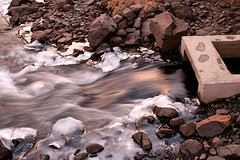
The glaciers and mountains of Iceland’s interior are perfect for hydro electric generation, and way back at the start of the 20th Century Iceland started to generate electricity from this resource.
Geothermal Electricity Production in Iceland
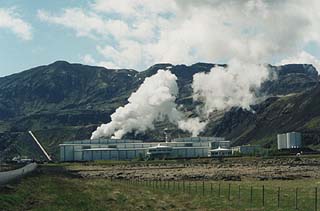
Half of Rejkjavic’s electricity supply is provided by the Nesjavellir Geothermal Power Plant pictured above. Located about 20 miles from Rejkjavic, the plant has three condensing steam units producing a total of 90MW of electricity. The plant is also used to heat water to 88 degrees Celcius for the capital to where it is piped down 800mm pipelines.
Natural conditions in Iceland provide a theoretical capacity of 64 TWh of geothermal electricity of which 25-30 TWh can economically and feasibly be exploited. Currently Iceland has harnessed under 7 TWh of this potential, and so in time could become an exporter of electricity to mainland Europe or the USA.
However, Icelanders prefer to ‘use it rather than lose it’, and so attract high-energy users to locate their businesses in Iceland. Data centres for cloud internet services for example are perfectly suited to Iceland where cheap renewable electricity is available and the ambient temperatures are relatively low year around reduced the costs of building and running cooling systems.
Geothermal Water Heating in Iceland
Icelanders waited until the 1940’s before they started tapping their geothermal resources to provide space and water heating for the capital city Rejkjavic. It is estimated that exploiting geothermal energy for space heating alone saves Iceland $100 million in imported fossil fuels.
130 of Icelands 160 swimming pools use geothermal water. The water is so warm that the pools are open-air and are open throughout the cold Icelandic winter.
Once geothermal water has been used to heat homes, it is often used to heat pavements and car parking spaces. 40,000 metres of streets in the capital Rejkjavik are kept snow free using this technique.
Iceland’s Carbon Emissions
Ironically Iceland has one of the highest per head greenhouse gas emissions in Europe. Imported oil is used to power Iceland’s fishing fleet, cars and buses. Iceland uses more power per head than any other country in the world, primarily because of its fishing and heavy industry.
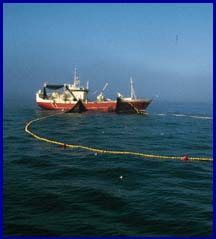
Over the next 20-30 years Iceland plan to use geothermal electricity to split hydrogen from water, and then to use hydrogen fuel cells to power its vehicles and fishing trawlers. This would make Iceland energy self-sufficient and 100% powered by renewable energy. However hydrogen powered buses and cars currently cost up to four times more than petrol and diesel equivalents. Sales of electric cars have been booming in recent years (since 2015), and their prices have finally become affordable which should lead to a reduction in emissions.
Find out more about Iceland’s renewable energy exploitation in this article (PDF): Renewable Energy in Iceland.