The majority of domestic renewable energy is generated to supplement an existing mains power supply – for example, an array of solar panels used to reduce the costs of powering a home.
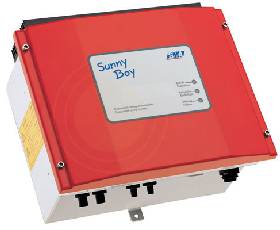
Unfortunately the cost of grid tie inverters with UK G83 approval (and professional installation) puts them well outside the price range of most small to medium microgenerators. Therefore, if a microgenerator with let’s say one 150 Watt solar panel and battery backup wants to power a lighting circuit in their home, they will need to look for alternative means to achieve their goal.
One way would be to separate the chosen lighting circuit completely from the mains power supply, connecting it directly to a suitable power inverter in turn connected to the renewable system battery bank. (See our article Dual Powered Lighting Circuit), or replacing the light bulbs and fittings with low voltage equivalents.
However, this is not an optimal solution since manual intervention is required when the batteries become overly discharged and the sun is not shining. Ideally we need a way to power the lighting circuit from the renewable source, but with an instantaneous automatic switch to mains power when necessary.
Using a Relay to Switch from Inverter to Mains Power
All power inverters have an automatic shut off function which prevents the attached battery bank from being overly discharged. When the voltage of the batteries falls to a certain fixed level, the inverter simply stops supplying power (sometimes sounding an alarm/buzzer at the same time). Using this information we can put together a simple automatic mains/inverter switch using just a 230VAC DPDT Relay.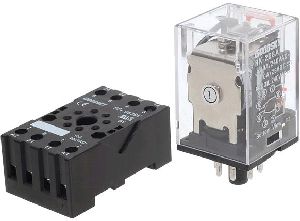
A DPDT relay (pictured above) has eight connections – two for the coil which should be connected to the live and neutral outputs from the power inverter, two NO‘s (normally open), two NC‘s (normally closed), and two COM‘s (common). When the relay is energised (i.e. when there is 230VAC across the coil from the inverter), NO1 is connected to COM1 and NO2 is connected to COM2. When the relay is not energised (when the power inverter is not putting 230VAC across the coil), NC1 is connected to COM1 and NC2 is connected to COM2.
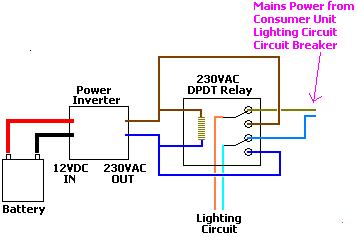
Therefore, connecting the relay up as shown in the schematic diagram above (and as per the list of connections below), the lighting circuit will be powered by the inverter when the inverter is outputting power from the battery bank, and the rest of the time directly from mains electricity. The switchover occurs in the fractions of a second.
Connections:
Inverter Live to Relay Coil
Inverter Neutral to Relay Coil
Relay COM1 to Lighting Circuit Live
Relay COM2 to Lighting Circuit Neutral
Mains Live to Relay NC1
Mains Neutral to Relay NC2
Inverter Live to Relay NO1
Inverter Neutral to Relay NO2
Buy a DPDT Power Relay
The relay pictured in this article is available from Rapid, for around £6, or a wide selection of similar relays are available from as little as £0.99 from eBay: DPDT Relay.
Advanced Inverter to Mains Switching
One problem with many power inverters is that the automatic switch off voltage is too low – for example 10.5V or 11V. By the time the battery or battery bank gets down to this sort of level of charge, it is pretty much empty and therefore being permanently damaged. To overcome this a low voltage disconnect should be added to the system to automatically turn off the inverter when the battery voltage has fallen below something like 12.0V.
Rather than using a relay to switch the positive cable from the battery to the inverter, where possible it is better to instead use a relay connected in parallel with the contacts of the on/off switch of the inverter since the current to be switched there will be much much less and constant. If you have no choice but to switch the positive wire from the battery, then the relay must be sized to cope with the absolute peak maximum current that will ever flow (even briefly) into the inverter.
Click here for details of the REUK Programmable Low Voltage Disconnect, or email neil@reuk.co.ukwith details of your system if you think you need something bespoke.
Safety
DISCLAIMER – mains electricity can KILL. We recommend that you talk to a qualified electrician before attempting to implement any of the ideas discussed in this article.