Waste Vegetable Oil (WVO) is the cheapest fuel for a diesel engine. Since this is a waste product (actually considered a hazardous material from cooking in pubs, restaurants, and chip shops etc you may even get paid to take it away! However, if you want good quality oil you may have to pay a little to pursuade your supplier to change their oil more frequently and to store it out of the rain and frost for you.
Oil older than a few months should not be used as it could be full of bacteria and fungus which are not very engine friendly. Put the WVO in a plastic container. If you cannot see through it, its probably no good.
Processing Waste Vegetable Oil
Before using waste vegetable oil in your car it must be filtered and any emulsified water removed. First it must be left in a settlement tank and heated up. A tank with a tap at the bottom is best as it faciliates the removal of any water (which will be at the bottom as it is heavier than oil). The tank needs to be heated either with an immersion heater or in a solar box (an example of which is pictured below. Obviously the immersion heater can be powered by wind power for example using a 200W 12V Immersion Heater.
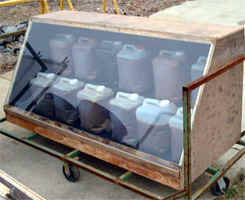
Ideally the WVO will reach around 60 degrees Celcius for optimum results as hot oil is much thinner than cold and so will pass through a filter much better. The water (which will be a white emulsion type liquid) should be drained off. The remaining warm liquid in the tank will still contain some undesirable animal fats, probably a little water, and sediment (e.g. burnt chips).
The liquid should be passed through a suitable filter (e.g. 1 micron bag/sock filters) to remove the sediment, and poored into storage containers together with a little solvent (white spirit) and left for a few weeks to settle.
The honey like liquid at the top of the container is your free fuel, and the cloudy liquid at the bottom of the container can go back into your settlement tank ready for the next run.