A water butt is a container typically used for the storage of rainwater or greywater for garden irrigation. An enormous range of water butts are available from a few pounds up to many hundreds of pounds.
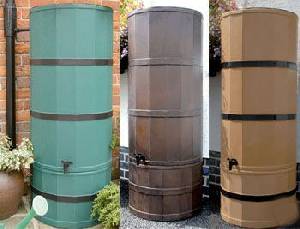
Water Butt Sizes
Water butts are available in a huge range of sizes from just 50 litres to 1,000+ litres. The most common (and therefore best value for money) are those in the range of 150-250 litres storage capacity.
The size of water butt chosen depends on the size of the garden to be watered, the frequency of rainfall, and the space available for the water butt. Another consideration is the size and weight of the empty water butt since if the water butt is too large it will be difficult to get it home and to install it and/or move it around the garden if need be.
Prices of Water Butts
Water butts vary enormously in price considering that the vast majority of them are pretty much identical – a plastic storage vessel with a tap fitted at the bottom and a lid at the top. It is well worth shopping around to get the best deal. Expect to pay around £25-40 for a basic 200 litre water butt with lid and tap fitted.
Water butts in the range of 500 litres plus suddenly become very expensive costing much more – with five cheap 200 litre water butts typically costing less than half of the cost of one 1,000 litre water butt.
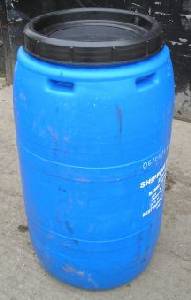
A great way to save money and to recycle is to use second-hand plastic containers as water butts. The recycled 200 litre (45 gallon) plastic storage tub pictured above is perfect. It has a secure childproof lid, is made of durable food grade plastic, and can be purchased for around £10 in steam-cleaned good as new condition. It just requires a tap to be fitted at the base – a simple task with water butt tap kits available from just £5.
Appearance
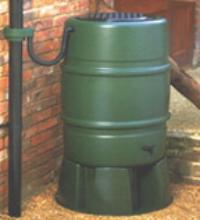
The majority of commercially available garden water butts are made from dark green plastic – however homemade butts made from recycled plastic storage vessels can be white, translucent, or often bright blue.
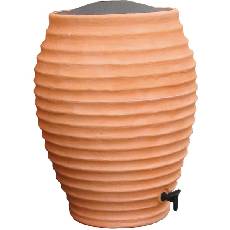
If the visual impact of a water butt is likely to be an issue then the enormous range of ornamental water butts available are likely to be of interest. Typically much more expensive and with lower water storage capacities, ornamental butts include recycled oak wine barrels and terracota style pots (see image above).
Water Butt Stand
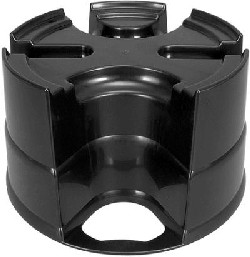
If a water butt is placed directly on the ground, it is not possible to get a watering can under the tap fitted at the base of the butt – therefore a water butt stand such as the one pictured above is essential. A stand can be as simple as a few stacked bricks, or a bespoke stand is often available for each marketed water butt (typically for around £10-20 for a 200 litre plastic water butt).
For safety the water butt must be very stable on its water butt stand . If a child were to climb onto an unstable water butt, he/she could be very seriously hurt.
Water Butt Lids
A lid is essential for a water butt. It keeps insects away, it stops dirt and dust getting into the water, it prevents the water being lost to evaporation, and most importantly – a secure lid is essential for child safety. If children are ever likely to go near to the water butt, the lid must be totally secure. If a child fell head first into a water butt the results could be tragic.
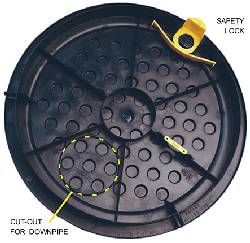
Child safety locks are available for some water butt lids and are well worth the minimal extra cost.
Connecting Water Butts Together
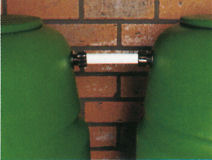
If a large water butt (e.g. 500-1000 litres) is required, it is often cheaper to connect a few cheap small-to-medium sized water butts (eg. 200 litres) together rather than purchasing one large expensive unit. Click here to read our article on linking water butts.