Albert Betz was a german physicist who in 1919 concluded that no wind turbine can convert more than 16/27 (59.3%) of the kinetic energy of the wind into mechanical energy turning a rotor. To this day this is known as the Betz Limit or Betz’ Law. This limit has nothing to do with inefficiencies in the generator, but in the very nature of wind turbines themselves.
Wind turbines extract energy by slowing down the wind. For a wind turbine to be 100% efficient it would need to stop 100% of the wind – but then the rotor would have to be a solid disk and it would not turn and no kinetic energy would be converted. On the other extreme, if you had a wind turbine with just one rotor blade, most of the wind passing through the area swept by the turbine blade would miss the blade completely and so the kinetic energy would be kept by the wind.
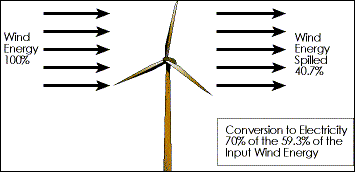
Real World Wind Turbine Power Efficiencies
The theoretical maximum power efficiency of any design of wind turbine is 0.59 (i.e. no more than 59% of the energy carried by the wind can be extracted by a wind turbine). Once you also factor in the engineering requirements of a wind turbine – strength and durability in particular – the real world limit is well below the Betz Limit with values of 0.35-0.45 common even in the best designed wind turbines. By the time you take into account other ineffiencies in a complete wind turbine system – e.g. the generator, bearings, power transmission and so on – only 10-30% of the power of the wind is ever actually converted into usable electricity. (see the graphic above from the Iowa Energy Center, USA.)
Horizontal axis wind turbines (HAWT) theoretically have higher power efficiencies than vertical axis wind turbines (VAWT) however wind direction is not important for a VAWT and so no time (and power) is wasted chasing the wind. In turbulent conditions with rapid changes in wind direction more electricity will be generated by a VAWT despite its lower efficiency.
To find out more about Calculating the Power of the Wind and how it affects wind turbines click here. To understand how much electricity a wind turbine can actually generate in the real world of fluctuating wind speeds click here for our Wind Speed Weibull Distribution guide.
Comments
Very few individuals have a correct understanding of the Betz limit and the efficiency of a turbine. The 59% figure given by Betz is really a power coefficient and not an actual efficiency. Efficiency should be calculated by dividing power output by the kinetic energy of the air that passes thru the turbine. In the Betz limit, the energy in the air is calculated as a product of the energy per unit area upstream times the area of the actuator disc. In the Betz calculation the result is a denominator that contains more energy than actually exists in the stream. Using the upstream area and velocity, the maximum efficiency turns out to be 88.8% as compared to the Betz result of 59 %. I like the Wikipedia derivation of the Betz limit.
Dr. Richard M. Andres
Professor Emeritus
Saint Louis University
1st September 2010