A DC voltage booster, DC voltage multiplier, or DC-DC Step-Up Converter is a very useful tool which enables a low source DC voltage to be boosted (stepped up) to a higher output DC voltage which is more useful.
For example, ultrabright LEDs need a 2.5-3.5 Volts to light: even two AA rechargeable batteries in series (1.2 + 1.2 = 2.4V) would not provide sufficient voltage to light up LEDs. Using a voltage boost circuit an LED can be powered by just one AA battery or any other power source – sometimes down 0.7 Volts!
This circuit can be used with low voltage solar panels to make a small battery charger or to power a 5 Volt device directly. It is also particularly good for getting useable voltages from small DIY stepper motor wind turbines – again to charge batteries or light LEDs.
The MintyBoost
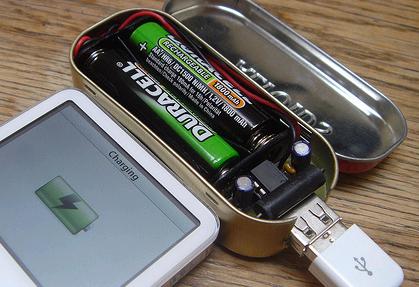
The origin of the voltage booster circuit described in this article is the Original MintyBoost – a DIY device to power / recharge any USB device (e.g. then an iPod, and now iPhones and other smartphones) using just two rechargeable AA batteries. MintyBoost kits are available for sale ($19.50 in USA), however the circuit can be made with easy to find electronic components together with a MAX756 integrated circuit chip and put to alternative uses.
(Jan 2014 Update – at the end of this article we have added details of the ready built voltage boost circuits which are now available priced at just £1 each.)
There is an excellent forum where you can ask questions regarding the MintyBoost and find a wealth of useful information about its possibles uses, construction, and modifications.
MAX756 3.3V/5V Step-Up DC-DC Converter
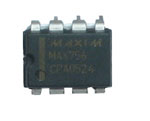
The key component in this voltage booster is the MAX756 – an integrated circuit from MAXIM . This tiny chip boosts input supply voltages as low as 0.7 Volts to an ouput of 3.3 or 5 Volts (user selectable) at up to 87% efficiency. The maximum output current is 200mA which is sufficient for a wide range of applications including LED lighting, and the low minimum voltage input enables the full capacity of batteries to be used up.
The full MAX756 Specification Sheet (PDF 120K) is available for download here.
Making the DC-DC Converter
The following parts are necessary to make this 0.7 to 5 Volt DC boost converter together with leads and either prototyping breadboard or soldering equipment and a board:
1 x MAX756
2 x 100uF Capacitors
2 x 0.1uF Capactitors
1 x 1N5817 Schottky Diode
1 x 22uH Power Inductor
The MAX756 is available direct from MAXIM with prices ranging from $3.02 (ordering 1-24) down to $1.95 (ordering 1000+). We can supply the rest of the components through the REUK Shop if required – email us to request a quote listing the components and quantities you require.
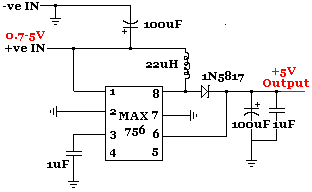
Circuit Diagram
Pictured below is the (not very photogenic) finshed circuit on prototypying breadboard.
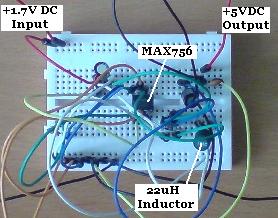
The above circuit was tested using two ‘flat’ AA rechargeable batteries. The total voltage of the batteries was measured at 2.21 Volts, and the output voltage from the circuit was measured at exactly 5.00 Volts with a digital multimeter. The output voltage was used to power an ultrabright LED for 24 hours (through a 270 Ohm current limiting resistor) without any sign of dimming during that time.
3.3V Output from MAXC756
The circuit above is used to boost DC voltages from 0.7+ Volts up to 5.0 Volts. By changing the input to pin 2 of the MAX756 from ground to positive, the output is switched to 3.3 Volts. This enables some LEDs to be lit without needing a series resistor or with a smaller resistor, so there is less power wasted as heat.
The 3.3 Volt DC output can also be used to trickly charge a couple of AA batteries (in series) with the sub-200mA current output from the MAX756.
Alternative Circuit
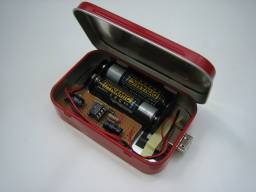
Details of an alternative, but similar, USB Battery Pack circuit are available by clicking here. As with the MintyBoost, it is designed to power USB devices with the output from a couple of AA batteries however the circuit can be put to many other uses.
Instead of the MAX756, an LT1073 (specification sheet (1.4MB) here) integrated circuit is used. This chip is designed to be used in single-cell (e.g. one AA or AAA) to 5V converters.
Buy Ready Built Voltage Boost Circuits
Since we originally published this article back in 2007 a huge number of step up voltage boosting circuits have come on the market which are incredibly cheap. The majority of these need a minimum input voltage in the range 3-5 Volts, but there are now (Jan 2014) quite a few available which are single cell to 5V (or more) converters.
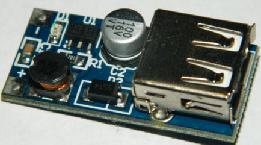
Pictured above is one of our favourite step up DC converters. This tiny (34mm x 16mm x 4mm) device takes in a DC voltage of 0.9V to 5V and outputs a stable 5V (up to 600mA current) to a female USB socket. Therefore you can simply plug your USB charging cable into this converter to charge your phone or other USB powered gadgets from a single AA battery.
At the time of updating this article, the pictured converter was available for £2.15 including postage from UK seller 4265steven. Click here for the full range of 1-5V step up converters with USB output: USB Step Up Converter with prices starting from under £1 in bulk and under £2 for one. These devices will output around 200mA at 5V with a single AA and 300-600mA with two AA cells, and they offer very high conversion efficiency at over 95%.