Everyday millions of gallons of expensively treated potable water is flushed down the toilet in the UK. Ideally we would all use rainwater to flush our toilets however this is not considered a practical option for most people. An alternative is to reduce the amount of water used in each flush.
Modern toilet cisterns use around 7-8 litres of water per flush, with pre-1993 models typically getting through 9-12 litres. This is far more than is actually necessary to flush a toilet fully and so one of the following products can be used to reduce the amount of water used per flush by 1-3 litres.
NEW – Click here to read our new article on the Interflush WC Water Saving Device suitable for retrofitting to toilets with a syphon flush.
Hippo the Water Saver
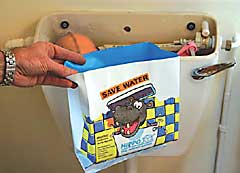
Hippo the Water Saver is a robust polyethylene bag which is sat at the bottom of the cistern. When the toilet is flushed, up to 3 litres of water is held in the Hippo preventing it from going down the toilet. To prevent the water in the Hippo from stagnating, a small hole in its bottom lets water slowly circulate throughout the cistern.
Saving 3 litres per flush is enough to reduce the water usage of an average family by 10-15% (according to independent research). If the Hippo is to be used with a very modern small water efficient toilet cistern, then it can be easily be adjusted (with a pair of scissors) to reduce the amount of water held back with each flush.
Free Hippo Water Savers
A FREE Hippo can be obtained by visiting the Thames Water Order a water-saving device form. Customers of Thames Water can request up to fifty FREE Hippos, everyone else has to content themselves with just the one.
More Hippo Water Saver Information
More information and purchasing instructions for the Hippo can be found at the official Hippo the Water Saver Website.
Save A Flush
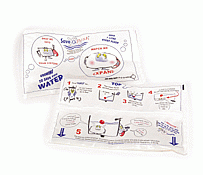
The Save-a-Flush (aka Waterman or cistern bag) is a bag which is placed in the bottom of the cistern underneath the flush float. Within 6 hours its contents swell up displacing one litre of water. Therefore every time the toilet is flushed, one litre less of water is used up.
Note that the Save-a-Flush is only suitable for toilets manufactured before 2001 with a flushing volume in excess of 7 litres. Toilets manufactured since 2001 typically have flush volumes from 4-6 litres.
Full illustrated instructions for using the Save-a-Flush are printed on the bag itself.
Free Save-a-Flush Bags
Severn Trent Water will send out up to four Save-a-Flush bags FREE of charge. Click here to view the Order a Save-a-Flush bag page.
Thames Water (with the Northmoor Trust) will send one FREE bag. Click here to view their Claim your Free Save-a-Flush System page.
More Save-a-Flush Information
More information and purchasing instructions for the Save-a-Flush are available at the official (and colourful!) Save-a-Flush website. The installation instructions which are printed on the bag can be viewed by clicking here.