Most photovoltaic (PV) solar panels are fitted in a fixed location – for example on the sloping roof of a house, or on framework fixed to the ground. Since the sun moves across the sky through the day, this is far from an ideal solution.
Solar panels are usually set up to be in full direct sunshine at the middle of the day facing South in the Northern Hemisphere, or North in the Southern Hemisphere. Therefore morning and evening sunlight hits the panels at an acute angle reducing the total amount of electricity which can be generated each day.
Click here to read our guides to Solar Insolation and Solar Panel Mounting Angle to better understand the effect of the seasons and the direction a solar panel is facing on the amount of heat (or hot water) which can be generated.
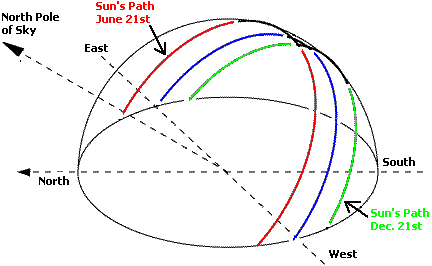
During the day the sun appears to move across the sky from left to right and up and down above the horizon from sunrise to noon to sunset. This is shown in the schematic above of the Sun’s apparent motion as seen from the Northern Hemisphere.
Solar Trackers
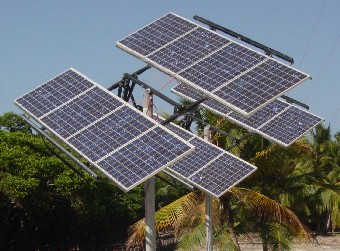
A solar tracker is a device onto which solar panels are fitted which tracks the motion of the sun across the sky ensuring that the maximum amount of sunlight strikes the panels throughout the day by keeping the panels facing perpendicular to the direction of the sunlight.
A good solar tracker can typically lead to an increase in electricity generation capacity of 30-50%, but it will use up some power itself and there are obviously financial costs associated with putting together and maintaining a solar tracker which need to be considered – for example, it may be cheaper to increase the size of your solar array than to install solar tracking.
When we first published this article back in 2007, the cost of a solar tracking system compared to the PV solar panels themselves was relatively low. Therefore, if you had 1000 Watts of PV solar panels, it would cost less to install a solar tracker than to purchase the additional 300-500 Watts of PV solar panels necessary to match the average daily electricity output possible if the 1000W of panels were mounted on a solar tracker.
As PV solar panels were expensive, it made financial sense for all but the smallest PV solar systems to be mounted to a tracker in most cases. However, the cost of solar panels has now (article updated Jan 2014) fallen to such an extent that purely financially the obvious choice is to install additional panels if you want to generate more electricity.
However, many people are limited by planning restrictions and space on the physical size of their solar array, so solar trackers still have their place. As they track the sun, double axis solar trackers particularly increase the amount of electricity generated in the early morning and late afternoon which is useful for powering baseline loads in the home. This is well worth considering if for example you sell surplus electricty to the Grid, since it is better to use the electricity you generate immediately rather than selling the surplus (cheaply) and then having to buy it back at (more expensive) retail rates.
How to Solar Trackers Work
There are many different types of solar tracker which can be grouped into single axis and double axis models.
Single axis solar trackers can either have a horizontal or a vertical axle. The horizontal type is used in tropical regions where the sun gets very high at noon, but the days are short. The vertical type is used in high latitudes (such as here in the UK) where the sun does not get very high, but summer days can be very long.
Double axis solar trackers have both a horizontal and a vertical axle and so can track the Sun’s apparent motion exactly anywhere in the World. This type of system is used to control astronomical telescopes, and so there is plenty of software available to automatically predict and track the motion of the sun across the sky.
Tracking the Sun
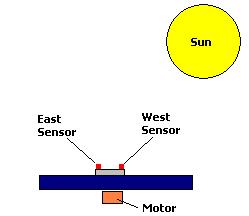
Above is a simplified schematic diagram of a vertical-axis solar tracker fitted to a solar panel located in the UK (high latitude Northern Hemisphere). A pair of sensors (typically a type of cadmium sulphide photoresistor, or LEDs are used) point to the East and West of the location of the Sun.
The light detected by the Eastward-facing sensor is at a lower intensity to that detected by the Westward-facing sensor. Therefore, the solar panel must be turned westwards (by the motor controlled by the solar tracker circuit) until the levels of light detected by both the East and the West sensors are equal. At that point the solar panel will be directly facing the sun and generating electricity optimally.
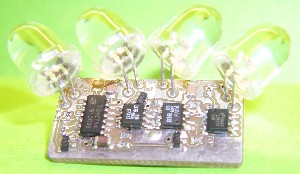
Obviously real world solar trackers (such as the one pictured above) are not so simple. A solar tracker must be able to reset itself at sunset so it is ready for sunrise, it must cope with heavy cloud, and it must work reliably 365 days a year. In addition a mount for the solar panel must be constructed which can cope with strong winds, and a suitable high torque motors or linear actuators found.
Buy a Solar Tracker
A wide range of commercial solar trackers are available – typically in Australia, USA, and Germany. There are also great plans available free of charge online for building your own DIY solar tracker from easy to find components. Read on for some useful online commercial and DIY solar tracker resources.
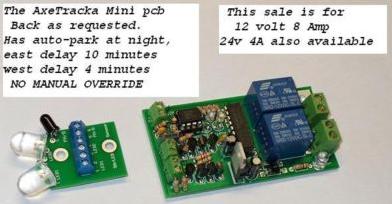
Pictured above is one example of a solar tracker controller from Australia priced at around £30. Click here now for an excellent selection of different solar tracker controllers with prices starting at just £20: buy Solar Tracker Controllers.
Full kits are now also available including sensors, motors, electronics, and more.
Additional Useful Solar Tracker Links
NEW Find out more about what is probably the simplest solar tracker possible with our new article Simple Solar Tracker Concept.
Redrok – A collection of DIY electronic projects including solar trackers, solar charge controllers, shunts and much more. Complete solar tracker circuits are available for sale.
Sun-Tracking Circuit for Solar Arrays.
Wattsun Solar Trackers – a division of Array Technologies.