It is often useful to know how fast the rotor blades of wind turbine generator are turning – particularly during development. The amount of power generated is directly related to the speed of rotation, and the speed of rotation depends on the speed of the wind hitting it.
There are a few ways to measure the speed of rotation of a wind turbine, from trying to judge it visually to expensive optical and other tachometers. In this article we will look at how a basic cycle computer can be used to measure the RPM of a wind turbine cheaply and effectively.
Cycle Computers
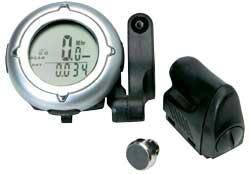
Cycle computers are basic electronic devices which are used by cyclists to measure their speed and distance covered. A small magnet is fitted to one of the spokes on the front wheel, and a sensor to the front fork (the inverted U-shaped metal which holds the wheel in place).
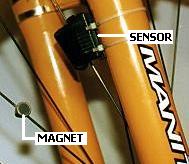
Every time the magnet spins past the sensor it sends a signal to the main computer which is usually fixed to the bicycle’s handlebars. Since the diameter of the wheel is known, speed and distance covered can automatically be calculated and displayed for the cyclist.
Cycle Computers as RPM sensors
In essence a cycle computer is already an RPM sensor. However to use it as such we have to undo the clever calculations which the computer does to display speeds and distances.
Since different types of bicycles have different diameter wheels (e.g. 26 inches on mountain bikes, 27 inches on some racing bikes etc), cycle computers let you input the diameter of the wheels of your bicycle. To use the computer as an RPM sensor we simply set the wheel circumference to 166.66 cm, and display the speed output in km/h. When the computer displays a speed of 20.6 km/h, it is measuring 206 RPM. When it displays 31.6 km/h, it is measuring 316 RPM, and so on. Just ignore the decimal point and you have a very accurate measure of RPM rotational speed.
Cycle Computers and Wind Turbines
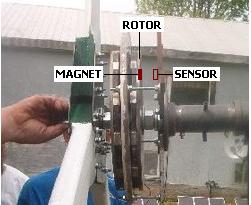
The range of the cycle computer magnet sensor is very short, therefore it is not practical to stick the magnet on the end of one of the turbine blades and the sensor on the turbine mast. Instead the magnet should be superglued to the edge of the permanent magnet generator or alternator, and the sensor to the wind turbine mounting bracket in such a way that the rotating magnet passes in front of the sensor without touching it.
Average Speed and Maximum Speed (RPM)
Cycle computers do not just display the current speed – they also store the average speed and top speed recorded. Therefore you can leave the cycle computer fitted to the wind turbine all night and next morning find out the average RPM and the top RPM recorded during the night. This is a very useful feature – and particularly interesting the morning after heavy gales.
Choosing a Suitable Cycle Computer
When choosing a cycle computer to use as a wind turbine RPM sensor the one essential feature is the ability to manually set the diameter or circumference of the wheels. The typical permitted range of circumference values is from 60cm to 229cm – so our 166.66cm is not a problem. The manual setting feature is found on 99.9% of cycle computers so you would really struggle to find a cycle computer unsuitable for use as a wind turbine RPM sensor.
Cycle computers are available in both wireless and wired versions. The wired versions are cheaper, but will require you to extend the two-core wire (using cheap bell wire) down the length of the mast to where the cycle computer will be mounted and viewed. The wireless versions are more expensive and will not always have sufficient range to allow the computer at the bottom of the mast to detect the transmitted pulses from the sensor at the top of the mast.
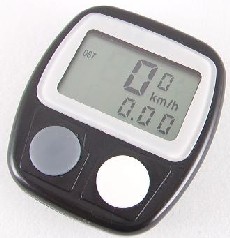
The cycle computer pictured above costs just £0.99 plus £4.00 for postage from Hong Kong (on eBay). It is a wired-computer, includes the magnet and sensor, and the wheel circumference (166.66 cm in our case) can be manually entered very easily.Cycle computers are all waterproof to a certain degree, however the better (and more expensive) computers have better waterproofing and will last longer when left out in the elements.