A wind turbine generator is made up of two major components – the turbine blades which are spun by the wind, and an alternator which converts wind energy into electricity. While it is possible to purchase a sealed alternator unit, it is not particularly difficult to make your own alternator using neodymium magnets and magnet wire.
Generating Electricity
All alternators work because of the effects of moving magnets past wire. When electrons flow through a wire a magnetic field is created around it. Similarly when a magnetic field moves past a wire, electrons are pushed through it. Therefore, by moving magnets past a wire we make electrons move through it, thereby generating electricity.
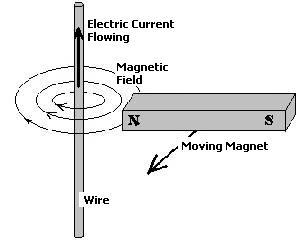
If instead of a single wire (pictured above), we have many individual wires, the same current of electricity will be generated in each wire. Since it is not practical to have lots of connected individual wires in an alternator, coils of wire are used instead.
Coils and Magnets
When the north pole of a magnet passes a coil, current flows in one direction around the coil. When the south pole of a magnet passes a coil, current flows in the opposite direction around the coil.
When the magnetic field is at 90 degrees to the coil windings, the most electric current is generated. When the magnetic field is parallel to the coil windings no electric current is generated.
Ideally you want each radial leg of a coil to be over a magnet at the same time – one leg over a north pole and one over a south pole – to maximum current generation.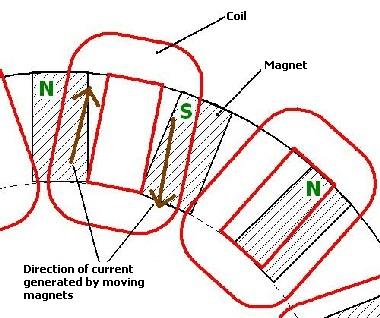
In the diagram above you can see how electric current in the left radial leg of the coil is pushed upwards (clockwise) by the north pole of one magnet, and in the right radial leg it is pushed downwards (also clockwise) by the south pole of the next magnet.
If both radial legs were over magnets with the same polarity – i.e. both north poles, the generated currents would cancel one another out: the left side of the coil generating a current in the clockwise direction, and the right side of the coil generating a current in the anticlockwise direction resulting in no current flowing around the coil.
Therefore alternator rotors are made up of magnets with alternating polarities – N S N S and so on, and the coils are sized so that the distance between the two legs is equal to the distance between two side-by-side magnets.
Voltage and Current
The voltage and current generated depends on the strength of the magnets, the number of turns of wire in the coils, the distance between the coils and the magnets, and the speed of the magnets passing the coils. The polarity of the voltage – i.e. the direction the electricity flows depends on the polarity of the magnet – north or south.
The voltage output by an alternator made of coils and magnets is therefore Alterating Current (AC), with the direction of the current changing every time the legs of the coils pass over a magnet.
Axial Flux Alternators for Wind Turbines
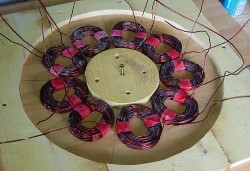
Click here for a guide to designing and building Wind Turbine Axial Flux Alternators for more information.