It is essential that the blades on a wind turbine generator are correctly balanced whether you have a cheap pair of home made PVC wind turbine blades or you’ve gone to the trouble of carving your own wooden wind turbine blades.
In practice it is unlikely that the alternator / generator will be perfectly balanced, so the process of balancing the blades will actually balance the whole unit.
If the wind turbine blades are not correctly balanced then they will not perform efficiently in low winds, and in strong winds terrific vibrations will quickly destroy your wind turbine generator as its components will be over-strained.
How to Balance Wind Turbine Blades
Wind turbine blade balancing is actually a very simple process, but you must do it on a totally still day (i.e. no wind), or do it indoors. Pieces of lead flashing (used by roofers) work best as they are soft (easy to screw in place) and very dense. Lead flashing can be obtained in flat sheets from a builder’s merchant or you can use fishing weights which you have hammered flat.

Method One
Fix the blades onto the alternator in what you intend to be their final positions labelling each blade and corresponding position on the alternator accordingly so that you can take everything apart and put it back together again correctly in future.
Now gently spin the turbine and leave it too come to a complete stop. Whichever side is the heaviest will finish at the bottom (6 o’clock position). Raise the heavy side up to the 3 o’clock position and add a weight on or near the hub at the 9 o’clock position. Keep adding more weight here until it balances – i.e. the weight(s) remain at the 9 o’clock position with the previous heavy side not moving from the 3 o’clock.
Gently spin the turbine a few more times. If it stops at the same point each time, then that is the new ‘heavy side’ and you need to repeat the steps listed above. Very quickly you will have a well balanced wind turbine and you will not need to re-balance it again unless you replace a damaged turbine blade in the future.
Method Two
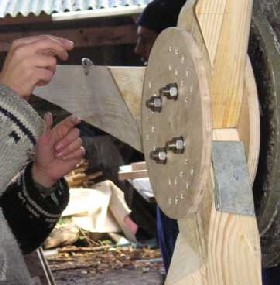
A second way to balance wind turbine blades (pictured above) is with a weight and a tape measure. Spin the turbine around to get one of the blades in the horizontal position. Stop the turbine. Sit a weight on the blade as close to the hub as possible. Slowly move the weight outwards until it causes the turbine to rotate – measure this point. Repeat this with each of the blades of the wind turbine generator.
If the three measurements are the same then the blades are all balanced. If however the measurement for one of the blades was greater, that blade is lighter and so a lead weight should be screwed to the alternator where the light blade connects to it.
Method Three
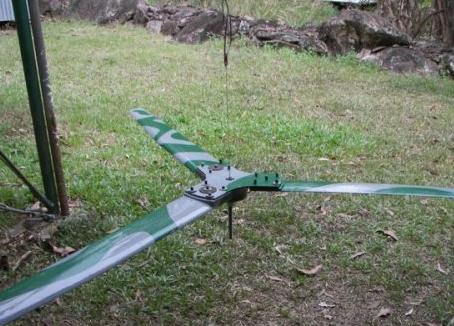
A third way to balance wind turbine blades is to hang the blades and hub from its centre using very strong string as shown above (image from TheBackShed.com – see link below). Add weights where necessary near to the hub until the blades all sit level.
Further Information
Balancing Wind Turbine Blades – balancing wooden blades for a Fisher and Paykel motor/generator wind turbine.
Wind Turbine Blade Balancing – discussion on the FieldLines forum.
Turbing Balancing by Hanging – from TheBackShed.com.