| RSS Web Feed for Renewable Energy UK | REUK Shop | Bookmark Site | About Us  

Building Your REUK 3 Phase Bridge Rectifier


Building Your REUK 3 Phase Bridge Rectifier

Instructions on putting together the REUK three phase bridge rectifier kit

education
Printer Friendly Version Print Article     

These are the instructions for putting together the 3 Phase Bridge Rectifier Kit available from the REUK Shop. Please read them through fully before starting to assemble your bridge rectifier kit.

Identifying the Kit Components
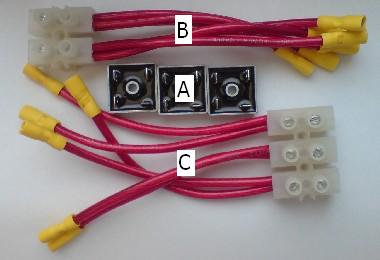
Kit Components

The kit is made up of three main components. Three MB356 35 Amp Bridge Rectifiers (A), one positive/negative connector (B), and one three phase connector (C).

The Bridge Rectifiers
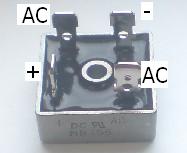
Bridge Rectifier

Each bridge rectifier has four legs - one positive leg (labelled on the side of the metal cladding with +, one negative leg (diagonally opposite the postive), and two AC legs (one is labelled AC on the cladding with the other diagonally opposite).

The Connectors

The positive/negative connector has three wires coming out of each of two terminal blocks. The three negative wires are marked with a ring of black insulating tape. The other three wires are the positives.

The three phase connector has two wires coming out of each of three terminal blocks.

The yellow insulated crimp connectors fitted to the end of each wire are all labelled with either I, II, or III indicating the bridge rectifier to which they should be connected.

Building the Kit
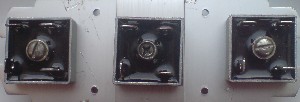

The Bridge Rectifiers Screwed to a Heat Sink

The three bridge rectifiers should ideally be screwed or bolted to a suitable heat sink. They should be positioned at least one inch apart so that any heat generated within them is dissipated. The bridge rectifier on the left will be called I, the central bridge rectifier II, and the bridge rectifier on the right III.
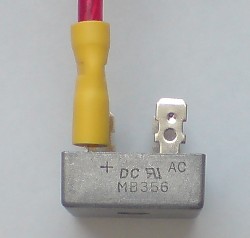
Plugging Connector onto Bridge Rectifier Leg

Plug the three positive connectors (those at the end of the positive wires) to the + legs of the three bridge rectifier - wire I to bridge rectifier I and so on. Do the same with the negative wires connecting them to the leg diagonally opposite the + leg of each bridge rectifier.

There are two wires for each phase of the AC electricity input - two for bridge rectifier I, two for bridge rectifier II, and two for bridge rectifier III. Plug the two connectors labelled I from the three phase connector onto the AC legs of bridge rectifier I, and do the same with the connectors labelled II and III with bridge rectifiers II and III respectively.
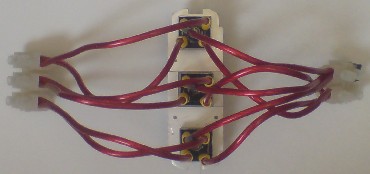
Completed Bridge Rectifier Connections

Your three phase bridge rectifier is now complete!

Connecting the Bridge Rectifier

It is very simple to connect your new bridge rectifier into your renewable energy system

The Three Phase Live AC Inputs

The three live wires from your wind turbine or other AC electricity generator should be inserted into the three holes on the three phase connector and locked in place by tightening the locking screw. Which live wire goes into which hole is not important.
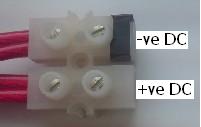
The Positive/Negative Connector DC Outputs

The negative DC output wire should be inserted into the negative terminal of the positive/negative connector (labelled with black insulating tape), and the positive DC output in the other hole.

Useful Advice

The supplied bridge rectifiers are very robust, however you need to be careful. The connected wires give a lot of leverage and so it is possible to accidently bend a bridge rectifier leg. This will not cause the bridge rectifier to fail however repeated bending of a leg may eventually lead to metal fatigue and component failure.

When plugging and (particularly when) unplugging the connectors from the legs of a bridge rectifier always push/pull the yellow crimp connector rather than tugging on the wire. Repeated strong pulling of the wire could cause the crimp connection to come loose and/or bend a bridge rectifier leg.

When selecting a heat sink, SIZE MATTERS. The bigger the better. Ideally squirt some heat sink compound between the bridge rectifiers and the heat sink to help the generated heat to dissipate. The heat sink pictured in these instructions is small for three bridge rectifiers. However, with each bridge rectifier given a heat sink such as this (reclaimed from an old Pentium II PC and easily available for 10p or 20p at car boot sales etc), then it would cope well with higher currents.

Article Last Modified: 11:46, 29th Mar 2007


Recommended Related Articles

People who read this article also enjoyed the following articles:

Make A Bridge Rectifier From Diodes
Make your own single or multi phase bridge rectifier from diodes
Article Last Modified: 15:33, 2nd Feb 2007
wind | electric circuit

Making a Bridge Rectifier
Find out how to make a bridge rectifier for your wind turbine
Article Last Modified: 16:17, 22nd Mar 2007
electronics | wind

Three Phase Basics
Get an understanding of three phase wiring in wind turbine alternators
Article Last Modified: 09:56, 19th Mar 2006
wind | electric circuit | websites

Buy 35A Bridge Rectifiers
Buy 35A 600V MB356 Bridge Rectifiers in the UK
Article Last Modified: 09:43, 30th Jul 2007
electronics | wind

High Current Voltage Regulation
Connect voltage regulators in parallel to increase the current which can be regulated
Article Last Modified: 17:16, 5th Dec 2007
electric circuit | electronics | general

Bridge Rectifier
Find out more about bridge rectifiers.
Article Last Modified: 15:33, 2nd Feb 2007
electronics | wind | wave

High Capacity Alternative to 9 Volt Battery
Get ten times the capacity of a 9 Volt battery to power your devices
Article Last Modified: 09:39, 7th Jun 2008
general | electric circuit | solar

Solar Shed Lighting Circuit Testing
Analysis of a typical solar shed LED lighting circuit
Article Last Modified: 11:56, 31st Mar 2007
lighting | solar | education | electric circuit

LED Spotlights
Find out about Energy Efficient LED spotlights
Article Last Modified: 15:07, 7th Jan 2008
lighting

Permanent Magnet Generator
Build a wind or water power system with around a PM Generator
Article Last Modified: 17:33, 2nd Jan 2008
wind | hydro

© 2006-2008 REUK - All Rights Reserved
Page Last Updated on 3rd July 2008 at 01:32:13pm

Latest
Articles


Uniross Rechargeable Batteries and Chargers
Find out more about the Uniross range of rechargeable batteries and battery chargers
storage
13:32, 3rd Jul 2008

C and D sized Rechargeable Batteries
Find out where to buy true high capacity C and D sized cells
storage
13:27, 3rd Jul 2008

Can You Run Your Car On Biodiesel
Is your vehicle suitable for running on biodiesel?
biomass
16:40, 2nd Jul 2008

Simple Sump Pump Controller
Put together a sump pump controller with two float switches and NO electronics
water
16:02, 2nd Jul 2008

Sump Pump Control System
Put together a fully automatic system to reliably pump out the water collected in a sump pit
water
16:02, 2nd Jul 2008

Energy Efficient Driving
Find out how to drive your car most efficiently
transport
10:46, 1st Jul 2008

Hypermiling to Increase MPG
Use hypermiling techniques to reduce fuel consumption
transport
10:46, 1st Jul 2008

EcoBalls Laundry Kit
Find out more about using EcoBalls instead of detergent
water
13:18, 30th Jun 2008


REUK Shop

Popular Items


KILL A WATT
Plug in Mains Power and Energy Monitor
£19.99 each.
Energy Saving


EFERGY HOMECO2METER
efergy homeCO2meter wireless electricity monitor
£38.99 each.
Energy Saving


240V LED SPOTLIGHT BULB
240V LED GU10 bulb. 20 x 20,000mcd white LED 1 Watt bulb
£4.99 each.
Energy Efficient Lighting


RAINWATER DIVERTER KIT
Rainwater diverter kit for standard plastic 65mm square and 68mm round downpipes
£8.99 each.
Water Conservation


300 WATT POWER INVERTER
Convert 12V DC battery power into 230 AC to power portable televisions, computers, video recorders etc. 300 Watt power rating - peak power 600 Watts
£29.99 each.
Renewable Energy System Parts


12 VOLT 3 WATT SOLAR PANEL
Waterproof 12 Volt 3 Watt Solar Panel - 199 x 136mm with fitted leads (fiberglass and resin).
£19.99 each.
Solar Power


SUNGUARD SOLAR CONTROLLER
4.5 Amp at 12 Volt solar charge controller - fully encapsulated and weatherproofed
£22.79 each.
Solar Controllers