Fixed Voltage Regulators
Use a voltage regulator to obtain a fixed voltage supply (at <1.5 Amps) from a variable source
electric circuit | electronicsIn a previous article we covered how the
LM317T voltage regulator chip can be used to obtain a fixed voltage from a variable supply. Looking at a typical
renewable energy system
12V battery bank, the output from the batteries can rise to 15V+ when they are being heavily charged. In order to power lower voltage devices from such a battery bank, some kind of
voltage regulation is essential.
LM317 / LM317T
The
LM317T is a very common
voltage regulator (available from the
REUK Shop) used to obtain a fixed voltage of between 3 and 40 Volts set using a couple of
resistors. Click here to read up on
using the LM317T to regulate voltage.
Fixed Voltage Regulation
While the
LM317T is relatively simple to use, having to add a couple of resistors adds unnecessary complexity if you just want a fixed voltage of say 5 Volts at around 1 Amp - for example, for a simple
solar battery charger powered from a 12V solar panel or 12V battery bank.
Permanently
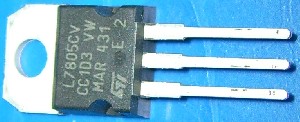
fixed voltage regulators are available which require no resistors - the output voltage is internally fixed. The
L7800 Series of positive voltage regulators can handle an output current of
up to 1.5 Amps, and regulators are available with output voltages of 5, 5.2, 6, 8, 8.5, 9, 12* (pictured above), 15, 18, and 24 Volts.
*
A couple of volts are dropped (i.e. lost) in these regulators
, so the 12V regulator cannot be used reliably with a 12V battery bank to obtain a fixed 12V ouput.
These fixed regulators are available cheaply (well under £1 each) and are very simple to use in practice.
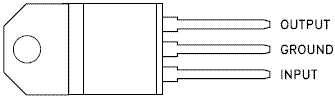
Using an L7806CV Voltage Regulator
The
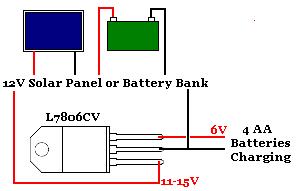
L7806CV is a
voltage regulator from
ST which will provide a fixed output of 6 volts (5.75-6.25V in reality) from an input voltage from 9V to 35V. Therefore, it it suitable for use for a
4 AA Battery Charger to be powered from a 12V solar panel or battery bank.
Further Information
The
L7800 Series Positive Voltage Regulators Technical Specifications (PDF) can be downloaded here.
Article Last Modified: 10:17, 21st May 2007Comment on this Article
If you have any comments on this article, please email them to
neil@reuk.co.uk.
Recommended Related Articles
People who read this article also enjoyed the following articles:
Using The LM317T To Regulate VoltageUse an LM317T to regulate voltage in renewable energy projects
Article Last Modified: 15:04, 7th Mar 2008electric circuit | electronicsSolar Battery Charger With LM317TFind out how to make a current controlled solar battery charger using an LM317T
Article Last Modified: 08:34, 30th Mar 2007solar | education | electric circuitLED Dimmer CircuitFind out how to put together a simple but efficient PWM dimmer circuit for LEDs
Article Last Modified: 09:42, 16th Mar 2011lighting | electronics | electric circuitPut Together an REUK Solar Lighting KitFull construction plans for solar powered shed or garage lighting using LED spotlights
Article Last Modified: 13:36, 25th Apr 2007solar | lighting | electric circuitUsing The LM317T With LED LightingUse an LM317T to regulate the current in LED lighting projects
Article Last Modified: 12:47, 12th Mar 2008lighting | electric circuitLM317T Voltage Regulator ChipLearn about the LM317T and its uses in renewable energy projects
Article Last Modified: 13:35, 9th Sep 2008electronics | electric circuitMake A Bridge Rectifier From DiodesMake your own single or multi phase bridge rectifier from diodes
Article Last Modified: 15:33, 2nd Feb 2007wind | electric circuitWhat is a ShuntFind out what is a shunt resistor and how it is used in RE applications
Article Last Modified: 12:52, 28th Feb 2007electric circuit | educationLED SpotlightsFind out about Energy Efficient LED spotlights
Article Last Modified: 13:31, 29th Jul 2008lightingMake a Shunt ResistorMake your own rough and ready shunt resistor
Article Last Modified: 12:52, 28th Feb 2007electric circuit | education