Tiny wireless CCTV cameras such as the one pictured below have many uses from security surveillance to wildlife observation. Thanks to electronics miniaturisation, the images which can be obtained are excellent despite the physical size of the camera, and can be viewed on a laptop or other computer (fitted with a TV card) or on a standard television when connected to the CCTV receiver.
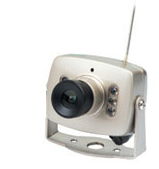
Wireless CCTV Cameras are the perfect application for solar power. A typical wireless CCTV camera requires just 50 to 300mA of 6.5 to 9 Volts DC electricity to operate – usually being powered by a 9 Volt battery, or via a mains adapter (not exactly wireless!).
Unfortunately, as our article High Capacity Alternative to 9 Volt Batteries describes, the capacity of a 9 Volt battery is typically very low – sufficient to power even the most efficient short-range wireless camera for just a few hours. Therefore, a PV solar panel with battery backup offers the optimal solution.
NEW If you are not interested in building your own DIY solar powered wireless CCTV system, take a look at our latest article introducing Solcam Solar Powered Wireless IP Camera – an integrated unit with solar panel, battery pack, and high quality outdoor security camera which connects wirelessly to your broadband router enabling live video to be viewed from anywhere in the world via the internet.
DIY Solar Powered Wireless CCTV System
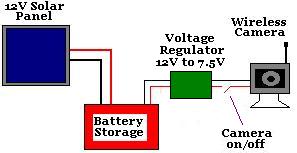
Since a wireless CCTV camera requires more than 6 Volts to operate, a 12 Volt Solar Panel should be used. This should be connected to a battery backup so that the canera can still be used during cloudy weather, at night (if it is an infrared camera), and in the early morning and late evening when the sun is low.
Battery Storage
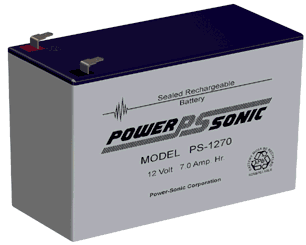
Either a deep-cycle sealed lead acid (SLA) or around 8 AA rechargeable batteries (in series) can be used as battery storage for the system. The initial cost of purchase of both options is similar (assuming 8 x 2,700mah AA cells, or a 2.9AH 12V SLA battery) and both have their benefits and problems.
NiMH rechargeables can release hydrogen at temperatures below zero but they are easy to purchase and can be drained fully and recharged 1,000 times.
Lead acid batteries on the other hand are heavy, cannot be delivered via the standard postal service, and should not be drained below around 40% of capacity if they are to last long. But, they cope much better with being trickle-charged, and are available in large sizes for energy hungry cameras which are to be left on 24hrs per day.
Getting the Correct Voltage to the Camera
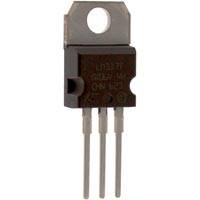
Since the CCTV camera requires a voltage of around 6.5 to 9 Volts, a voltage regulator such as the LM317 (pictured above) should be used. (Click here to read our article on Using the LM317 to Regulate Voltage – for example, to obtain an output voltage of 7.5V R1 = 240 Ohms, and R2 = 1200 Ohms).
NEW The REUK Shop now has complete LM317T-based 8.5V voltage regulators for sale which are perfect for use within solar powered wireless CCTV systems.
Sizing the System
Different wireless CCTV cameras draw different currents. Those with a short transmission range typically use from 50-100mA of current, whereas long-range models can eat up to 300mA. You also need to consider the number of hours that the camera will be on per day and when those hours will be.
If the camera is to be left on 24 hours per day then since there are only 4-5 good hours of sunshine per clear day in the UK, the current flowing into the batteries needs to be at least 6 times (24 divided by 4) more than the camera current.
With a 50mA camera, this means that a 3-400mA 12V solar panel (approximately 5 Watts) would be required to keep the batteries topped up and to provide enough power for the camera. If a solar charge controller is not to be used, the battery requires a capacity of at least 10 times the maximum current flowing into it which would be 4 Ahrs in this example.
NEW Find out how to put together a Solar powered nest box CCTV system by clicking here.