
While this controller is suitable in most cases it is not ideal for use with swimming pools. One key difference is the need to set a maximum temperature to prevent the pool from becoming unpleasantly hot. Therefore, in this article we will introduce our new solar pump controller designed specifically for use with swimming pools.
Solar Pump Controller Features
Our standard solar pump controller is actually quite simple. A temperature sensor is fitted to the hot water storage tank and another to the outlet from the solar panel. If the temperature of the solar panel is measured to be hotter than that of the stored hot water tank consistently for 30 seconds, then the pump is switched on. The pump stays on for a minimum of 10 seconds whenever it is turned on (to protect it from being damaged by switching on and off rapidly), and then is turned off immediately if the hot water tank is measured as being hotter than the fluid leaving the solar panel to prevent the stored water being cooled.
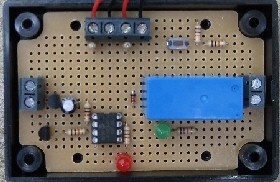
For the swimming pool version (pictured above) new functionality has been added – the ability for the user to programme in a maximum pool temperature. If the temperature of the pool is measured to be above the maximum desired, then the pump will not be turned on no matter what the temperature of the solar panel. If when the pump is on, the temperature of the pool exceeds the programmed maximum for 10 seconds consistently, the pump is automatically turned off.
Connecting up the System
With our standard solar water heating pump controller, the two sensors can be glued to the tank and solar panel outlet using heat sink compound. For measuring the temperature of the swimming pool with these non-waterproof sensors it is necessary to make a waterproof temperature probe. (Click here to visit our guide to Making a Waterproof Temperature Probe – an LM335Z temperature sensor fitted inside a stainless steel tube and filled with epoxy potting compound). The finished probe can then be dropped into the pool – ideally in a shady location for accurate temperature measurement.
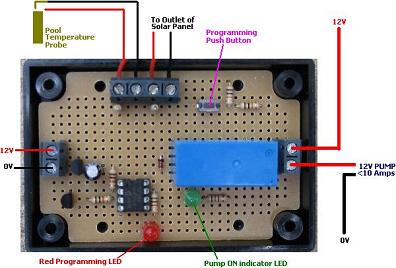
In order to keep the system as cheap and simple as possible, we do not include a digital display of the measured temperatures and pump status etc. Instead, if the user would like to have the temperatures displayed we suggest the use of one or more digital multimeters (available from as little as £4). Simply by measuring the voltage across the temperature sensors where they are connected to the circuit board, the temperature can be calculated since it equals 100 * (measured voltage – 2.73).
Using the Controller
The user can programme the maximum pool temperature using the small push button on the circuit board. By pressing and holding this button down for 1/2 a second, the circuit enters programming mode – red LED on for 2 seconds. When the LED turns off, the user presses the pushbutton X times where 1 time = maximum pool temperature of 25 degrees Cecius, 2 times = 27 degrees, 3 = 29 degrees, 4 = 31 degrees, 5 = 33 degrees and so on. After a pause of 5 seconds, the red LED flashes X times to give visual confirmation of the programmed setting. At any time, the user can press the button for less than 1/2 a second for the LED to be flashed X times as a reminder of the programmed setting.
Whenever the temperature of the pool is above the maximum programmed, the red LED blinks.
The controller uses a relay to switch the pump. When the relay is energised (closing its internal switch) the green LED is lit to give visual confirmation of its status.
Technical Details
This controller is based around a PICAXE microcontroller – the PICAXE-08M. This is powered from a 5.0V regulator and has ADC (analog-digital converter) inputs which can take in the temperature sensor values and convert them into a number from 0-255. The LM335Z temperature sensors output a voltage which is proportional to its temperature – 2.73V at 0 degrees C, plus 0.01V per degree above zero. Therefore at 25 degrees, the sensor outputs 2.73 + (25 * 0.01) = 2.98V.
The PICAXE ADC assigns a value of 0 for inputs of 0V and of 255 for inputs of 5V. For each (just under) 0.02V increase in input voltage, the value increases by 1. For example, if 2.98V (25 degrees Celcius) is input from a sensor, the ADC (using the command readadc) converts it to 2.98 / 5.00 * 255 = 152. For the temperature comparison part of the circuit (is panel hotter than tank) the microcontroller just checks whether the voltage input from the solar panel sensor is higher than that from the tank sensor. For the absolute temperature measurement requirement (to prevent pool being heated when it is already above the desired maximum temperature), it checks if the pool is above the maximum temperature.
Buy a Solar Pump Controller
If you are interested in purchasing this or any other bespoke solar water heating pump controller, please contact neil@reuk.co.uk with details of your exact requirements. Prices start from around £26 to £40 including the temperature sensors.