One of the biggest power consumers in the home is the fridge. Turned on constantly, opened frequently, filled with warm items needing to be cooled, and not generally very efficient, a fridge can often be responsible for a large chunk of the electricity consumed in a home.
In this article we will look how a humble chest freezer can be used as a fridge reducing electricity consumption by as much as 90%!
Chest Freezer
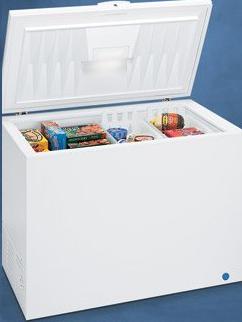
An example of a chest freezer is pictured above. They are typically used in large homes for long term deep freeze food storage, or in shops and supermarkets to give consumers easy access to frozen goods. There are three key differences between a typical domestic fridge and a chest freezer:
1) Chest freezers have a horizontal lid which you lift to access the contents. Warm air rises and cold air falls, therefore, when you open the vertical door of a fridge, a lot of cold air falls out and is replaced by air at ambient room temperature. This warmer air needs to be cooled down which of course increases electricity consumption. When the lid of a chest freezer is lifted, almost all of the cold air stays put exactly where we want it to be.
2) The insulation on chest freezers is as much as three times thicker than that built into a domestic fridge. This means that less electricity is required to maintain the temperature of the contents of a chest freezer.
3) The thermostat of a chest freezer is set to around -25 degrees Celcius whereas that for a fridge is usually set to between 2 and 6 degrees Celcius.
Therefore, as points 1 and 2 above show us, a chest fridge would be much more energy efficient and result in less carbon emissions than a typical domestic fridge. All that we need to do is find a way to modify, replace, or override the chest freezer thermostat so that it will maintain its contents at the desired 4 degrees Celcius rather than freezing them solid.
It is worth noting (and very surprising) that if you compare a fridge with a chest freezer of similar dimensions, the chest freezer with have a lower average power consumption despite having to keep its contents so much cooler.
Convert a Chest Freezer into a Chest Fridge
There are two ways to go about converting a chest freezer into a chest fridge. The first is to swap the fitted thermostatic temperature controller with one designed for fridges. This is very technical and well beyond the level of this article. The second option which we will discuss here is to use an external temperature controller. All that is required is a thermostat, a temperature probe to be fitted inside the chest freezer, and a suitably rated relay to switch the chest freezer power on and off as required.
There are many commercial thermostats available on the market which can be used un-modified to control the chest freezer, but these can be expensive. In addition, you ideally want to have hysteresis in the controller – i.e. it turns on chest freezer when its internal temperature goes over say 4 degrees, and turns it off again when it has fallen back down to 3 degrees. This greatly reduces the number of times the freezer compressor will be turned on/off per hour which reduces electricity consumption and wear on the freezer.
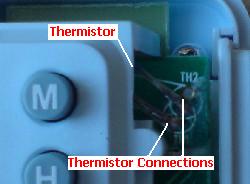
For the simplest system see our article Convert Thermostat to 12V Timer Switch in which we explain how to identify and replace the temperature measuring thermistor. Instead of replacing the thermistor, it could be carefully removed, fitted to long leads, re-connected to the thermostat, and used to reliably measure the internal temperature of the chest freezer (which would be switched on/off by the latchingrelay of the thermostat).
More Information and Useful Links
A fridge that takes only 0.1kWh a day – Detailed article by Tom Chalko first published in Australia’sRenew magazine in 2005.
Freezer to Fridge Conversion – from the Otherpower.com discussion board.
Refrigeration Engineer – Some words of warning and things to consider.
Comments
I stumbled across this REUK article. I have been using a freezer as a fridge for 2 years now. All I did was purchased an A+ rated chest freezer from local papers (75€) and a 230V Temperature Controller with Probe from eBay for under a tenner. Mounted the controller in an ABS box (lying around) along with a flush mains socket to plug the freezer in to.
Then wired a short mains lead with fused plug to the box and ran the live to power the controller, then through the 30A relay, then to the Live on the socket. Neutrals all return to mains cable inside box to complete circuit and Earths all bond together. Mount the ABS box wherever convenient.
Drill a 5mm hole at the top through the freezer wall and drop the probe in so it measures temp about half way down (experiment) seal hole with a blob of white silicone in and out. Power up and set the controller to cooling mode and 6 deg C with no variance (relay NC at 7 deg NO at 6). Works like a charm; not sure if it’s good for the compressor long term to keep cutting the power in full flow but no problems so far.
When I get round to it will fit a bit of white 10 mm trunking inside the freezer to cover the probe and cable as it flops around a bit and could get damaged over time. Not sure about consumption we have a couple energy plugs somewhere I could plug in for a week to see but the trouble is they reset when the power goes so would have to plug in the wall outlet to the box rather than the box itself. Our old upright American fridge freezer was using 3 or 4 Kwhr per day so it had to go. We also have a small A++ mains chest freezer that uses little energy. When you start living off 2400W solar panels it really makes you think about consumption. Wish I could get the kids to switch off the lights! Hope this helps.
Ricardo, May 2014