| REUK Shop | REUK Blog | Directory | About Us  |  | RSS Web Feed for Renewable Energy UK 

Introduction to Compost Toilets


Introduction To Compost Toilets

Find out more about compost toilets and how they work

water | recycling
  Printer Friendly Version Print Article     

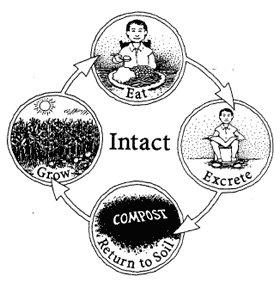
Cylce of waste when using a compost toilet

A compost toilet is a waterless toilet perfect for use in off-grid locations. Not only do compost toilets save water, they also create usable compost as a byproduct. With a typical domestic toilet getting through 45,000 litres of treated water per year, the compost toilet offers a water- and energy-saving alternative.
Compost Toilets

A compost toilet is typically made up of two chambers. One chamber which is in use, and one chamber which is left full for one year so that its contents can decompose fully. Once a year the full chamber is emptied, and the 'toilet' moved over it. The chamber which had just been in use has some extra plant matter (e.g. weeds and vegetable pealings etc) added to it and it is then left for its year of decomposition.
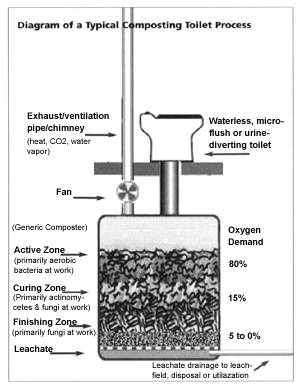
Diagram to show the way in which compost toilets work

A vent pipe is essential to prevent the toilet from getting smelly. As with a standard toilet, the top of the vent pipe should be at least 600mm above the roof apex. For a luxurious smell-free user experience, a fan (solar powered or otherwise) can be fitted into the vent pipe and automatically activated when the toilet seat is lifted. A drain at the bottom of the chamber enables excess liquid to run off to keep the chamber dry.
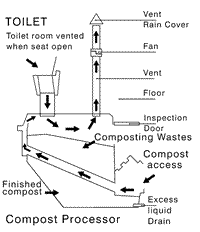
Another diagram of the workings of a compost toilet

Each time the toilet is used, soak (typically straw, sawdust, shredded paper, hay etc) is dropped in. This gives the bacteria living in the toilet chamber a suitable diet of carbon and nitrogen. Without the soak, the bacteria wouldanaerobically (without oxygen) digest a nitrogen-rich diet resulting in large amounts of smelly ammonia and hydrogen sulphide, together with nasty greenhouse gas methane. With the correct amount* of soak, the material in the chamber is decomposed aerobically (with oxygen) resulting in nitrates, phosphates, and sulphates - i.e. fertiliser - being generated and minimal greenhouse gases being released. * The ratio of soak to feces should be around 5:1 resulting in an optimal 40:1 to 70:1 carbon/nitrogen ratio.

Urine and Compost Toilets

The key to success with compost toilets is keeping urine separate. Too much urine in the waste chamber causes smelly anaerobic decomposition. Urine is naturally high in nitrates, phosphates, and sulphates, and so can be used (dilluted 1:10 in water) as a fertiliser for non-edible plants and trees.

Using Human Compost to Grow Crops
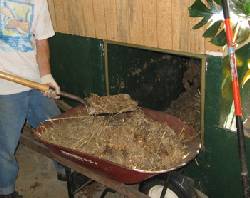

Humanure being removed from the chamber of a compost toilet

The fertiliser generated from decomposed human waste (aka humanure) can safely be used in the growing of crops. Within a few hours the vast majority of human pathogens die since they cannot survive outside the human body. After one year of decomposition the only nasty which can remain is a type of roundworm (Ascaris Lumbricoides) egg - these can survive for up to 10 years. Parasitic roundworm infection affects over 1 billion people worldwide.
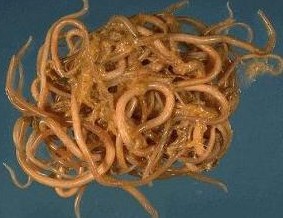
Roundworm Ascaris Lumbricoides.jpg

Because of this minimal risk*, it is usually recommended that this human compost is not used to fertilise vegetable crops, and instead is used for fruit trees and bushes, and non-edible plants.
* As long as you know that you and everyone else who uses your compost toilet does not have roundworm, this is not really an issue.

Benefits of Compost Toilets
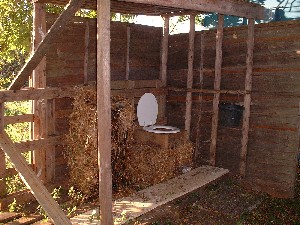

Outdoor compost toilet

There are many benefits to compost toilets compared to standard plumbed in toilets. No water is required, no pipes are needed, no sewage treatment is required, no chemical cleaners or bleach are used, no electricity is needed, and the end product can be used to fertilise the land returning organic matter to the soil where its nutrients are needed.

Humanure and Compost Toilet Reading


The Humanure Handbook - Joseph Jenkins

The Bible of humanure is Humanure Handbook: A Guide to Composting Human Manure by Joseph Jenkins - available in paperback for around £12.00.

Useful Related Toilet Links

For more information on saving water when flushing a standard toilet click here. To find out how to use collected rainwater to flush a toilet click here.


Article Last Modified: 10:48, 11th Aug 2007

Comment on this Article

If you have any comments on this article, please email them to neil@reuk.co.uk.


Related REUK Categories

water | recycling
© 2006-2013 REUK - All Rights Reserved
Page Last Updated on 17th June 2013 at 08:42:30pm

Recent
Blog Posts


1.Bricking a Beaglebone Black

2.Project of the Day – 12V High Power Regulator with LT1084CP-12

3.Raspberry Pi Temperature Datalogger with DS18B20 Sensor

4.New Raspberry Pi Category on REUK.co.uk Website

5.Special Offer of the Day – 20W PV Solar Panel £25.99

6.Reducing Reflectivity of PV Solar Panels to Increase Efficiency

7.Low Voltage Disconnect with Display and Datalogger

8.Saudi Solar Power Boom About to Begin

9.Compressed Air for Storage of Renewable Energy

10.Offer of the Day – 80W Monocrystalline Solar Panel £71.98


Latest
Articles


Solar Powered Raspberry Pi
Power your Raspberry Pi permanently from a PV solar panel
raspberry pi
20:42, 17th Jun 2013

Beaglebone Black Credit Card Sized Computer
Find out about the Beaglebone Black - tiny, low cost, low power use computer
raspberry pi
15:46, 14th Jun 2013

Power over Ethernet
Find out how to power your networked microcontroller projects directly via the ethernet cable
electronics
17:04, 13th Jun 2013

Raspberry Pi Temperature Logger with Xively
Make a Raspberry Pi temperature data logger accessible online with Xively
raspberry pi
20:44, 12th Jun 2013

DS18B20 Temperature Sensor with Raspberry Pi
Measure temperatures with a 1-wire DS18B20 sensor and Raspberry Pi
raspberry pi
20:37, 12th Jun 2013

Simple Raspberry Pi Relay Control over the Internet
Take your first steps in Raspberry Pi home automation - controlling a relay
raspberry pi
15:57, 6th Jun 2013

Raspberry Pi Flashing LED with GPIO and Python
Find out how to set up Raspberry Pi to flash an external LED using GPIO
raspberry pi
15:57, 6th Jun 2013

Connecting to Raspberry Pi from PC via SSH
Find out how to operate a Raspberry Pi directly from a Windows PC using SSH
raspberry pi
13:08, 5th Jun 2013


REUK Shop

Popular Items


REUK SUPER LDR DUSK DAWN RELAY CONTROLLER
Multi-function light detector triggered light/dark dawn/dusk relay controller
£19.95 each.
Complete Circuits


KARASOULI SCC 20 CHARGE CONTROLLER
20A rated wind turbine charge controller and dump load controller with blocking diode and heatsink
£43.95 each.
Renewable Energy System Parts


2013 SOLAR PUMP CONTROLLER WITH RELAY
New solar water heating pump controller with fitted 10A relay
£25.99 each.
Complete Circuits


REUK SUPER POULTRY LIGHTING CONTROLLER
Control up to 8 Watts of LED spotlights to stimulate egg production in birds
£29.99 each.
Complete Circuits


REUK SUPER TIMER 2
User programmable 12VDC powered 16A rated repeating relay timer. 1 second to 99 hours ON and OFF times
£23.99 each.
Complete Circuits


300 WATT POWER INVERTER
Convert 12V DC battery power into 230 AC to power portable televisions, computers, video recorders etc. 300 Watt power rating - peak power 600 Watts
£29.99 each.
Renewable Energy System Parts


CONVERTED PROGRAMMABLE DIGITAL TIMER RELAY
Mains powered programmable timer converted to low voltage with relay board
£21.99 each.
Renewable Energy System Parts


12 VOLT REGULATOR
Supply a fixed 12.0 Volt DC to your devices (up to 0.7 Amp output)
£4.79 each.
Complete Circuits


MR16 CERAMIC BULB HOLDER
Bulb holder for 12 Volt LED spotlight bulbs
£1.39 each.
Energy Efficient Lighting