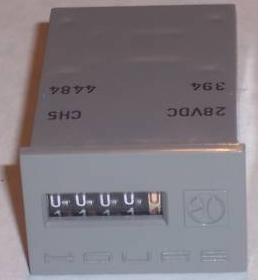
While there are many commercial elapsed time timers available (such as the hours elapsed timer pictured above), they tend to be quite expensive as they are designed for use in laboratories and in engineering.
Fortunately it is very easy to make something yourself which will accurately keep track of time elapsed using a battery powered clock. Clocks such as the IKEA alarm clock pictured below are available everywhere, cost just a pound or two.
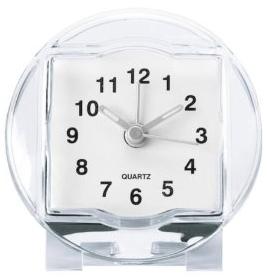
As these clocks have an hour hand, minutes hand, and seconds hand they can be used to time to 1 second resolution. They are powered by one AA (1.5V) battery, but will work accurately within the voltage range of around 1-2V typically so you do not need to be too careful.
In order to use such a clock as a time elapsed timer all we need to do is manually set the time to exactly 12 o’clock, and then find a way to supply power to the clock only when the event we wish to time is occurring. Thereafter, the hands of the clock will show the exact duration the clock has been powered and therefore show for how long the tested for event has occurred.
As an added bonus, the clock’s alarm can be set to sound after a certain time has elapsed, for example set the clock to 4 o’clock so that after four hours of the event have elapsed the alarm will sound.
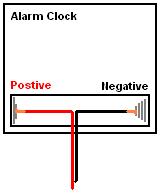
Firstly, having tested the clock works and is accurate, remove the battery, and solder leads to the battery contacts inside the clock battery bay as shown above. We will show one example below of how this clock can now be used as an elapsed time timer, but there are many other things which can be timed and ways to achieve it from very simple to more complex timers using microcontroller circuits etc.
Elapsed Time Timer Example
In this example, we would like to time for how long a window has been closed. To test if the window is open or closed a reed switch is fitted to the window frame and a magnet to the window. When the window is closed, the magnet is next to the reed switch and holds that switch closed (so electrical current can flow through it). When the window is open, the magnet is far from the reed switch so that switch is open (and so no electrical current flow through it).
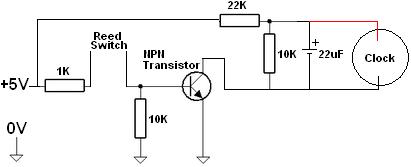
When the reed switch is closed (window closed) current flows into the base of the NPN transistor which allows the transistor to conduct current. The 22K and 10K resistors on the right side of the circuit act as a voltage divider so that 5V going in results in just over 1.5V getting to the clock, smoothed by the capacitor.
This whole thing could easily be powered by 4 AA batteries with a series connected total output voltage of 5-6V resulting in 1.5-1.8V getting to the clock through this circuit.
Other Examples
The reed switch can be replaced by a relay and therefore (depending on the relay chosen) used to detect and time when an appliance is on, or a simple light dependent resistor circuit could be used to measure the number of hours of light or darkness – for example, how long were the lights on in the office. Or the light detector could be used with the clock to detect the red LED on-light of a mains powered device – for example, how long have the kids been watching television or playing on the computer.
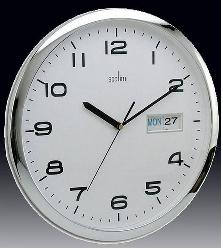
For timing longer than 12 hours reliably, a clock with a day date indicator can be used so that the number of elapsed days can be tracked.