Since toilet flushing uses so much water, and since the water used certainly does not need to be expensively treated drinking water, a toilet flushing system using collected rainwater is a great idea.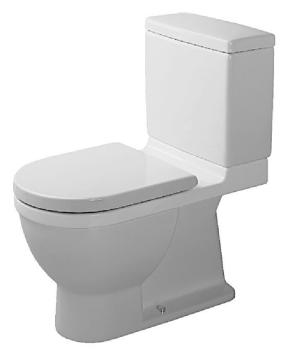
In our article Flush Toilet With Rain Water we looked at a very simple system in which rainwater is collected and stored in an elevated water butt which feeds water into the toilet cistern by gravity. Unfortunately such a system can be difficult and expensive to implement in virtually all cases in which the toilet is located above basement level. Therefore an alternative system to consider uses a pump to drive ground level collected rainwater up to a header tank in a property’s loft space from where it can be gravity fed into toilet cisterns.
Complete Rainwater Toilet Flushing System
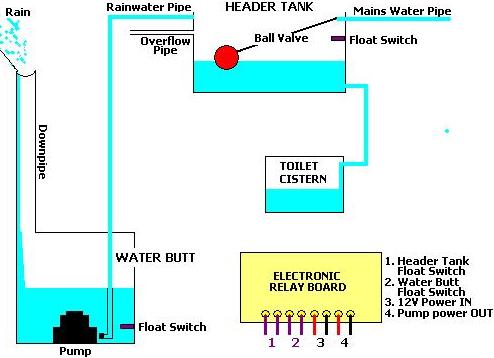
This rainwater toilet flushing system has few components, and can be put together very cheaply. The main items to be purchased are the water butt (rain barrel) and header tank – fortunately recycled butts and tanks can easily be used to keep costs low.
A mains water inlet needs to be installed so that the header tank can be topped up with mains water if there is no rain for a while. This inlet must be a minimum of 15cm above the height of the (also essential) overflow pipe. This meets with legal requirements and ensures that there is no chance of mains water being contaminated by dirty rainwater. An arm ball valve (of the type found inside toilet cisterns) can be extended and used to partially fill the header tank with mains water automatically when the tank is very low on water. This guarantees a year around uninterrupted water supply.
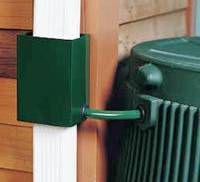
In order to collect rainwater, a simple rainwater diverter* is connected to the down pipe(s). As rain falling on the roof drips down into the gutters and then down the down pipes towards the drains, it is diverted into the water butt where it is stored.
* We sell a suitable Rainwater Diverter Kit in the REUK Shop.
A submersible pump is placed in the bottom of the water butt and used to push the collected rainwater up into the header tank. The pump chosen must be powerful enough to lift worthwhile amounts of water up to 5+ metres (depending on height of the property), but not so powerful that it uses too much electricity.
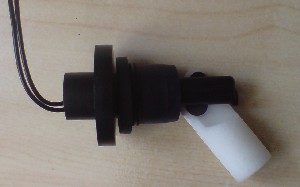
Finally an electronic system must be put in place which will detect the levels of water in the water butt and header tank and turn the pump on or off accordingly. A couple of Float Switches are used which ensure that the pump will never run dry when the water butt is empty, and that the pump will switch off when the header tank is full.
This simple system can be powered entirely from a renewable energy charged 12V Battery Bank. A 12V pump can be powered directly, or a 230V pump can be powered with a suitable inverter.
The Electronic System
The key component in this rainwater toilet flushing system is the electronic relay board which uses the status of the float switches to decide when to turn on the pump.
The electronics must do the following:
1) If the water butt contains water, and the header tank is not full – turn on the pump.
2) If the water butt is empty, or if the header tank is full – turn off the pump.
In order to prevent the pump being switched on and off cyclically, time delays need to be built in – for example, if the water butt is empty, it will take a while to refill again. Therefore, a multi-hour time delay is necessary to prevent the pump from being switched on until the water butt has had a chance to collect significant amounts of rainwater again.
Similarly, when the header tank is full, the pump should not be turned on again for a while (say 30 mins to 1 hour) since during that time it is highly unlikely a significant percentage of the header tank contents will be flushed down the toilet, and it is not ideal for the pump to come on every time the toilet is flushed.
Pumps with Integrated Float Switches
An alternative system which we have put together for some customers has proved to be very successful, and is suitable for use with pumps which have an integrated float switch.
A float switch or liquid sensor is fitted just below the overflow outlet of the header tank. A timer circuit is then used to automatically check the status of this switch/sensor every X hours (where X is the minimum conceivable time it would take to empty the header tank flushing the toilet(s): 4 hours is typical. If the header tank is found to not be full, then the pump is switched on for Y seconds/minutes (where Y is the time it takes to fill the header tank from empty). If during that time the header tank gets full, the pump is switched off by the timer circuit. If the rainwater tank is empty (or empties during pumping) then the pump will be automatically switched off by its integrated float switch and will therefore come to no harm.
Buy a Complete Electronic Pump Controller
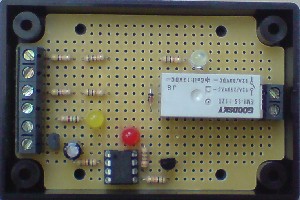
If you would like to purchase a complete pump controlling relay board for this type of toilet flushing system contact neil@reuk.co.uk directly with details of your requirements. The microprocessor board pictured above is fitted with power on, water butt contains water, and pump on LED indicators, a 12V 10A rated relay for connection to the pump, and all necessary time delays pre-programmed. A bespoke board such as this costs approximately £25.
Circuits for use with pumps which have an integrated float switch start from around £16. Click here to read our new article Pumps for Irrigation and Rainwater Harvesting which should help you select a suitable pump for your toilet flush system.