In our article Switch Mains Powered Appliances Safely we looked at how a low voltage system could be used to switch mains electricity safely via a wireless transmitter meaning no need to call in an electrician. Unfortunately as this ended up being quite expensive and fiddly to implement, we came up with an alternative solution which is cheaper, more reliable, and more flexible – based around a plug-in mains powered programmable digital timer.
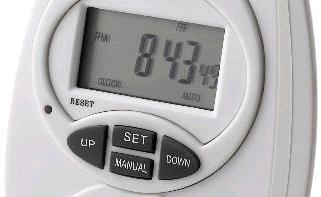
The timer pictured above is the TE7 programmable digital timer, and is available at Tesco (and via Tesco Direct) for under £10. It can be programmed with up to ten ON/OFF’s per day to switch mains powered devices which are plugged into it – however it can also be modified to be used in other ways.
The MANUAL button on the timer is used to cycle between the three modes: OFF, AUTO, and ON, and back again. When the timer is ON anything plugged into it will be turned on, and when the timer is OFF anything plugged into it will be turned off. If the timer is in AUTO mode then whether the device is on or off will depend on any set programmes entered by the user.
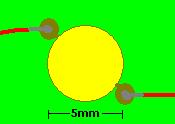
If you pull the rubbery MANUAL button out from the timer it exposes a set of contacts which look like the schematic drawing above. Note the scale – it is pretty small. If fine leads are (very carefully) soldered to the two circular points as shown above, then when they are shorted (i.e. their free ends make contact with each other) the timer will think that the button has been pressed and act accordingly.
Therefore, controlling a mains powered device just requires the two free ends of the soldered leads to be connected to the output contacts of a relay – one to the NO (normally open) and one to the COM (common) contact. When the relay closes, the leads will make contact with each other and cause the mode of the timer to change.
The only problem with using this method is that it is necessary to send two signals to get from ON to OFF (ON to AUTO, then AUTO to OFF) and similarly to get from OFF to ON – e.g. close the relay for 100ms, open it for 100ms, and close it again for 100ms. This requires some kind of electronic controller, but this can easily be incorporated into existing relay controlled circuits – e.g. our solar water heating pump controller to enable a mains powered pump to be controlled safely (without an electrician’s assistance), PIR motion detector to control mains powered lighting, and the controllers for mains powered pumps for our various irrigation and water harvesting systems.
Any device or appliance with a current rating of less than 13 Amps and to which a standard plug is fitted, can be controlled using the technique described above very safely. As an added benefit you also have a fully featured top of the range digital programmable timer to use with other projects.